
CARE-KNOW-DO: Doctoral Researchers’ Experiences of the METEOR programme Online
For doctoral researchers who participate mainly online in courses, programmes and events, cultivating collaboration, confidence and care can be more difficult than in face to face environments. In this article, online participants of The Open University (The OU) in the METEOR programme reflect on how values, learning, and action unfold at a distance through the CARE–KNOW–DO framework.
While funders and universities promote collaborative, socially engaged research, many doctoral researchers encounter these expectations in isolation—particularly in online environments. Drawing on online café conversation with The OU participants in METEOR’s online strand, this article examines how doctoral and early career researchers articulate what they care about, what they are learning, and how they are attempting to act together remotely, revealing both the possibilities and the practical challenges of cultivating collaborative research cultures without the in-person academy experience.
Introduction: Listening to Online Voices
Doctoral education is often described as intellectually demanding, yet emotionally and relationally isolating. Research consistently documents experiences of loneliness, uncertainty, and disconnection among doctoral candidates, particularly in training models that privilege individual achievement and solitary scholarship over collective learning and peer support (Newlands et al., 2025). At the same time, contemporary policy and funding discourses increasingly call for research that is collaborative, interdisciplinary and socially engaged research (Newman, 2024). Yet many researchers, particularly those in early careers, encounter these expectations without sufficient structured support for developing the requires skills, confidence, and professional relationships.
The METEOR programme (Methodologies for Teamworking in Eco-Outwards Research) was designed to respond directly to this gap. Funded through Horizon Europe, METEOR aims to strengthen the transversal skills of doctoral candidates and early career researchers by creating structured opportunities for international collaboration, mentoring, and proposal development, oriented towards research with societal impact (METEOR, 2025). Central to METEOR’s approach is the assumption that collaboration is not automatic, but a practice that must be intentionally learned, supported, and sustained. participants
This article explores how METEOR is experienced by The OU participants engaging exclusively through its online strand, rather than through in-person academies. This focus is critical because for online participants, collaboration unfolds without the immediacy of face-to-face interaction, informal social bonding, or intensive shared time (Morrison and Jaime, 2020). Instead, researchers navigate METEOR through digital platforms, asynchronous communication, and emerging relationships – often alongside full doctoral workloads, institutional responsibilities, and other commitments.
To examine these experiences, the article adopts thematic analysis of focus groups with eight out of thirty participants who provided their views. Our data include short segments of meaning, interaction shaping responses and perspectives recorded as quotes.
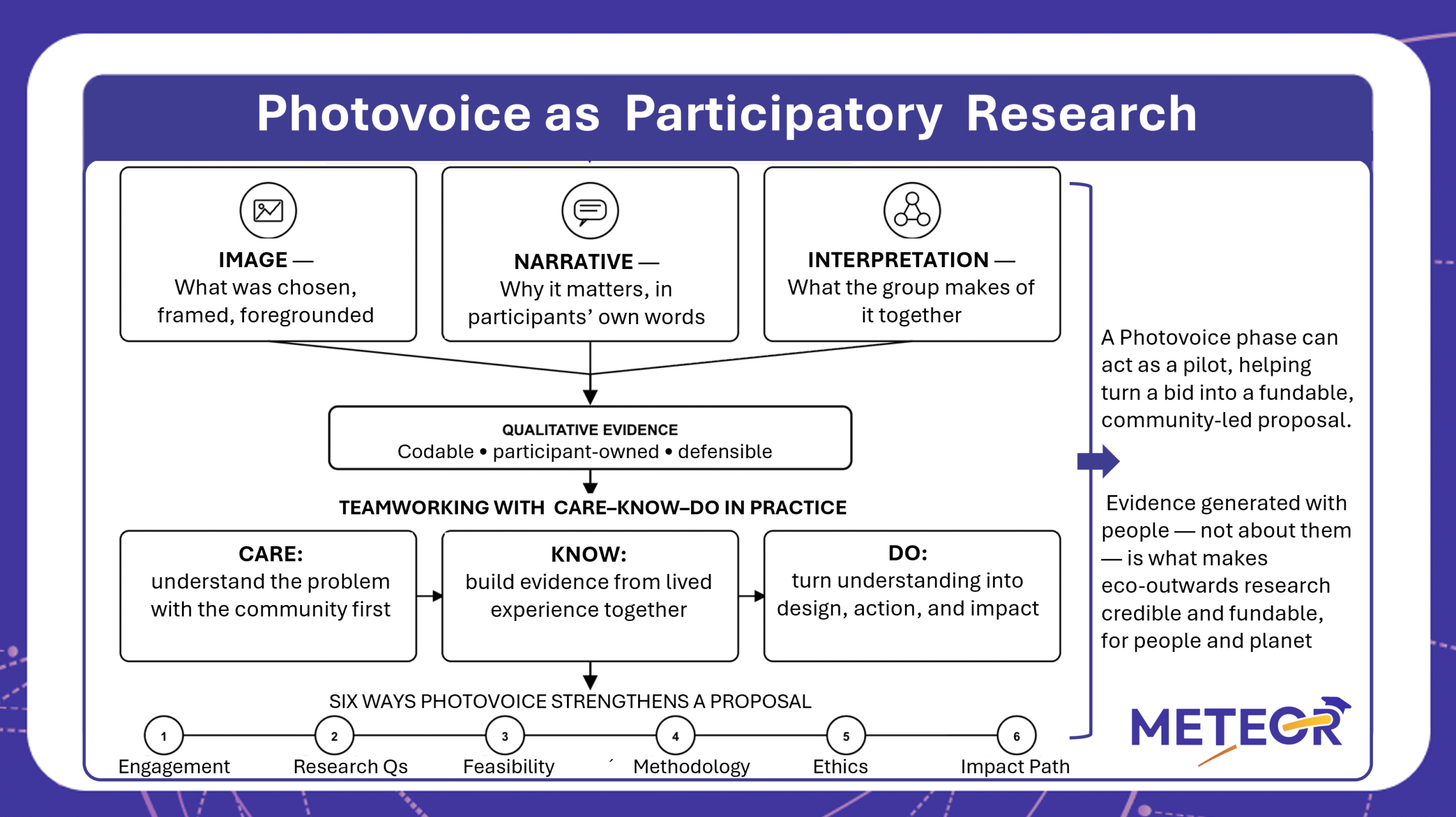
This article brings together several voices, analysed through the CARE–KNOW–DO framework adopted by METEOR. The online participants reflect on values (CARE), learning (KNOW) and action (DO) connected to their individual research, and on how these are relevant for interdisciplinary and international online teamwork within METEOR.
This analysis does not treat online participation as a weaker form of engagement. Instead, it shows how working online can surface hidden questions about motivation, confidence, coordination and belonging in doctoral research cultures. Our objective is to explore how doctoral and early‑career researchers understand the conditions necessary for collaborative, eco‑outwards research practices to take root, by listening closely to multiple views from researchers in different faculties, including Arts and Social Sciences (FASS), Wellbeing, Education and Language (WELS), as well as Science, Technology, Engineering and Mathematics (STEM).
What is METEOR?
METEOR is a three-year Horizon Europe funded project (2024-2027) designed to strengthen transversal skills of doctoral candidates and early career researchers (METEOR, 2026). Rather than focusing solely on disciplinary training, it fosters Peer Mentoring Groups researchers; online learning resources; expert mentorship and opportunities to co-develop research proposals. In the UK, METEOR is examining 8 key competencies for researchers (8C framework), which are: Collaborating, Communicating, Cultivating, Constructing, Comprehending, Co-creating, Coordinating and Catalysing (Okada et. al, 2026).
Importantly, METEOR is structured to be flexible and inclusive, enabling participation both through in-person academies and via online engagement. The discussion analysed in this article reflects the perspectives of participants who are navigating METEOR without the immediacy of face-to-face cohort building, relying instead on digital platforms, asynchronous communication, and early-stage group formation.
METEOR’s approach is grounded in eco-outwards philosophy, which positions research as embedded within wider social, environmental, and institutional eco-systems. This philosophy is operationalised through the CARE-KNOW-DO framework (Okada & Gray, 2023). In this article, CARE-KNOW-DO is not simply a conceptual model; it becomes a lens through which the tensions of distance, challenges, and early engagement are experienced.
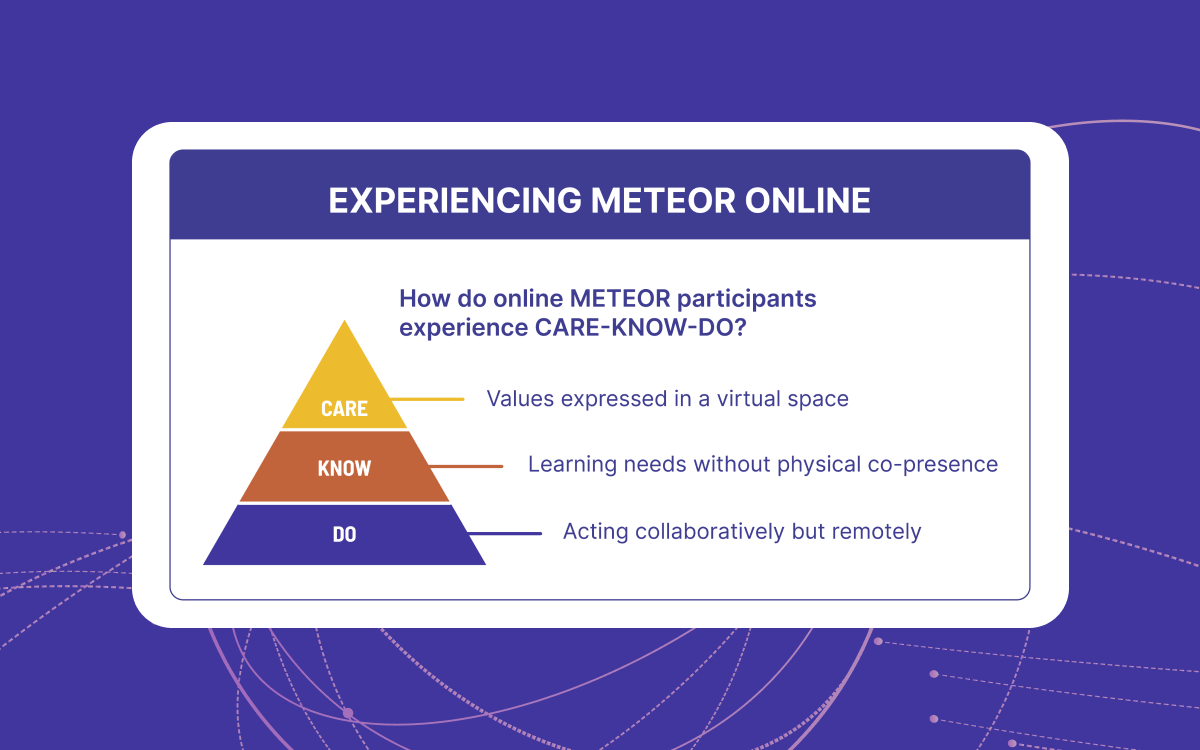
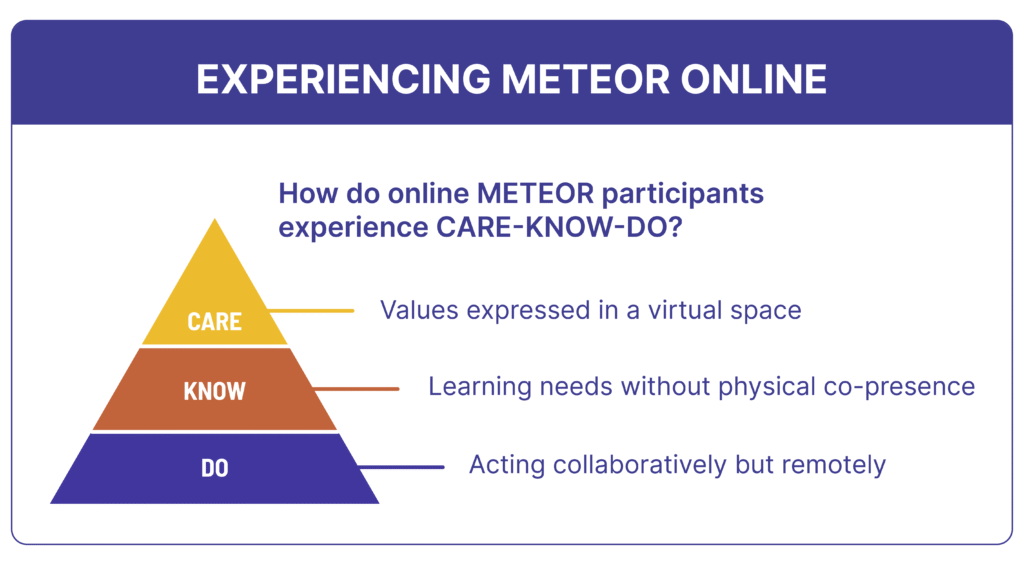
CARE: Values expressed in a virtual space
Despite limited prior interaction and the absence of in person bonding, the OU online METEOR participants articulated a strong and consistent set of shared values.
Commitments to inclusion, equity, and social responsibility emerged early in the discussion and shaped how participants positioned themselves within the group. Research was repeatedly described not as a neutral activity, but as something that should be aligned with what researchers “care about as people,” with an emphasis on ensuring that marginalised, excluded, or disadvantaged groups are not left behind.
Across the narratives, care was framed as both personal and professional. Research practice was described as inseparable from values such as gender equity, accessibility, and respect for lived experience. Inclusion was not discussed in abstract terms, but as something that should be actively enabled—raising questions about how inclusive principles are translated into everyday research decisions and practices. There was also a strong ethical orientation towards resisting extractive approaches and recognising learners, communities, and practitioners as holders of expertise.
To anchor these shared values, some illustrative quotes were clustered around the following concerns:
- equity and inclusion within research and professional trajectories
“Inclusion matters really deeply for me… inclusive health, availability and access to healthcare… in low- and middle-income countries and resource-constrained settings.” (part‑time, 2nd year in FASS)
“Equality and specifically equality of opportunities, accessibility of knowledge and education.” (part‑time, 3rd year in FASS)
- The importance of centring disabled voices and marginalised communities in research, and ethical concerns around extractive research practices and unequal power relations
“I really care about making sure disabled voices are heard and included in conversations where they might not otherwise be.” (part‑time, 4th year in FASS)
“I care about including the voices of those most marginalised in research… with a lens on gender and youth… contexts affected by gang violence.” A research manager/administrator (5th year) in WELS
“Research practices that are not traditionally extractive… balancing power dynamics… placing participants as the experts.” (ECR, 5th Year in WELS)
- A desire for forms of education and research that empower learners, communities, and practitioners
“Children having the chance to learn that draws on the wisdom of the people around them and their own wisdom.” (p-time, 1st year in WELS.)
“I really care that teachers are shown that same respect… listened to… and can shape the development around issues they care about.” (p-time, 1st year in WELS.)
Notably, these CARE oriented reflections often preceded any detailed discussion of methods, outputs or deliverables. In an online only context where collaboration has not yet solidified into routine practice, values appear to function as a key anchor for motivation and belonging. Articulating what mattered became a way of establishing common ground before working relationships had fully formed.
At the same time, various participants implicitly recognised the fragility of care at a distance. Without frequent interaction or shared experiences, sustaining a collective sense of purpose requires intentional facilitation and visible programme structures that reaffirm and support these shared commitments.
KNOW: Learning needs in the absence of physical co-presence
Under the KNOW dimension, online participants described a mixture of intellectual curiosity, anticipation, and uncertainty. Many brought strong disciplinary expertise but expressed limited experience in interdisciplinary collaboration, particularly across culturally and institutionally diverse European contexts. Learning was therefore framed less as mastering content and more as learning how to learn with others.
A recurring theme concerned the challenge of communicating research clearly beyond one’s own field. Explaining research to colleagues working on topics as diverse as, for example, international education, sustainable development, policy impact. These encounters highlighted the importance of clarity, translation, and adaptability, especially when familiar disciplinary language no longer “lands” in the same way.
Participants’ reflections clustered around two main learning needs:
- Navigating unfamiliar academic languages and epistemological traditions without feeling excluded or inadequate
“Aspects that make me feel very under-confident… I just think it will be confidence building.” (p-time, 1st year, WELS)
- Understanding how EU research cultures and funding expectations differ from national or institutional norms
“European funders… require certain kinds of writing and expression… very different from UK funders.” (part‑time, 2nd year, FASS)
“Gaining experience working on a Horizon or EU proposal for the future.” (full‑time, 5th year, in WELS)
Confidence emerged as a crucial epistemic issue. Two factors were shared, discomfort with academic terminology, and uncertainty about proposal writing as barriers to participation. Importantly, these concerns were not presented as individual deficiencies, but as shared conditions that METEOR might potentially help to address through collective learning.
For online participants, knowing was often framed in anticipatory terms. Unlike academy attendees who may already have experienced intense interdisciplinary teamwork, online participants frequently spoke in terms of what they hope to learn rather than what they have already practised. The online space therefore functioned as a preparatory environment where learning was still emerging.
DO: Acting collaboratively, but remotely
The DO dimension revealed the most pronounced divergence between aspiration and practice in the online context. Participants were clear about what they wanted to do through METEOR, often describing the programme as an opportunity to counter the isolation of doctoral research by working with people they “would never otherwise meet.” Doing collaboration was closely associated with networking, proposal writing, confidence building, and developing practical teamwork skills.
At the same time, participants spoke openly about the difficulties of enacting collaboration online. Communication within peer mentoring groups was often described as irregular or fragmented, with uncertainty about who was still active or even aware of messages being posted. Missed notifications, platform fatigue, and competing commitments made coordination labour intensive and sometimes discouraging.
Participants’ aspirations and challenges under the DO dimension clustered as follows:
What participants wanted to DO:
- Build international networks and relationships beyond their immediate institutions
“The chance to work with people I would never otherwise meet.” (part-time, 4th year, FASS)
- Learn how to co-write Horizon style research proposals
“Gaining experience working on a Horizon or EU proposal for the future.” ( full‑time, 5th year, WELS)
“European funders seem to require certain kinds of writing and expression….very different from UK funders.” ( part‑time, 2nd year, FASS)
- Develop confidence through collaborative action rather than solo work
“Imposter syndrome is a big problem for me… taking part in projects like this would give more confidence.” (part-time, 5th year, STEM)
“Aspects that make me feel very under-confident… I just think it will be confidence building.” A research project manager on Sustainable Development
- Practise communication and teamwork skills in real research contexts
What made this difficult online:
- Irregular or absent communication within peer groups
“My group hasn’t communicated at all… what happens if you move into another group?” (full time, 2nd year, FASS)
- Uncertainty about who is active or disengaged
“It’s about how to gather momentum… some clarity and communication to every team would be helpful.” (part‑time researcher , 2nd year, FASS)
- Missed messages or lack of notifications on digital platforms
“I didn’t get a notification… I have to actively remember to log in and check.” (A full‑time, 5th year, WELS)
- Difficulty sustaining momentum without structured meeting rhythms
“It’s about how to gather momentum… some clarity and communication to every team would be helpful.” (A part‑time, 2nd year, FASS)
These challenges did not indicate a lack of motivation. Rather, they highlighted the often-invisible labour involved in enacting collaboration online, especially for participants who are new to one another and juggling multiple institutional commitments.
For online participants, “doing” collaborative research is not yet routine; it was something tentative and still being learned. It requires scaffolding, clarity, and reassurance. The programme’s emphasis on care and inclusion arguably heightens sensitivity to these challenges, as participants are keenly aware that uneven participation can undermine collective goals.
Discussion: CARE–KNOW–DO Without the Academy
Viewing these insights through the CARE-KNOW-DO framework suggests that online participation reshapes the balance between the three dimensions.
- CARE is highly visible and strongly articulated, functioning as a motivational foundation
- KNOW is oriented towards aspiration and preparedness not only mastery
- DO is constrained by organisational and infrastructural factors rather than intent
This does not weaken METEOR’s model. Instead, it underscores the importance of differentiated support for online participants, whose learning trajectories may be less accelerated but not less meaningful. Crucially, the discussion suggests that online engagement is not a lesser form of participation. Rather, it surfaces latent issues, such as confidence, communication, coordination—that can remain hidden in intensive, short term face-to-face settings. Care and knowledge do not automatically translate into action; they need scaffolding, facilitation, and intentional design, especially at a distance.
Conclusion: Listening as Programme Development
This article has explored how doctoral and early career researchers participating in METEOR online articulate their values, learning needs, and desired actions through the CARE–KNOW–DO framework. Their reflections demonstrate strong alignment with METEOR’s eco-outwards principles, while also revealing the specific challenges of cultivating collaborative research cultures at a distance.
For METEOR and similar initiatives, the implication is clear: online participation requires intentional structures that translate care and knowledge into action. When these structures are in place, digitally mediated programmes can offer not only access and flexibility, but also deep spaces for reflexive, inclusive researcher development.
Online participation is not secondary to in person experience; it is analytically generative, foregrounding issues of confidence, communication, and coordination that matter for contemporary research cultures more broadly. In caring deeply, knowing reflexively, and striving—sometimes imperfectly—to act together, these researchers are already doing the work METEOR seeks to enable. The challenge, and opportunity, lies in supporting them to do so with greater ease, connection, and confidence.
Authors: Jane Doka, Alexandra Okada, Pallavi Joshi, Merim Baitimbetova, Katie Robinson, Claire Hedges, Carolina Szyp, Samantha Osys, Jennifer Horne, Gemma Weir
Author Contributions (CRediT): JD contributed to the investigation, formal analysis and writing – Original draft, AO developed the investigation framework, contributed to formal analysis and Writing. The co-authors contributed to Data Production, Review & Editing.
Citation: Doka, J; Okada A; Joshi, P; Baitimbetova, M; Robinson, K; Hedges, C; Holland-Szyp; C; Osys, S; Horne J; Weir, G. CARE-KNOW-DO: Doctoral Researchers’ Experiences of the METEOR programme Online. Published by METEOR – Methodologies for Teamworking in Eco-Outwards Research. CC BY-SA 4.0.
Keywords
Online doctoral collaboration, CARE–KNOW–DO framework, Transversal researcher skills, Narrative inquiry, Inclusive research practices
References
METEOR (2026). Methodologies for teamworking in Eco-outwards Research. Available at: https://www.meteorhorizon.eu/meteor-programme/.
Morrison, S. and Jaime, S. (2020) Challenges and barriers in virtual teams : a literature review, SN Applied Sciences. Springer International Publishing. Available at: https://doi.org/10.1007/s42452-020-2801-5.
Newlands, F. et al. (2025) ‘“ A PhD is just going to somehow break you ”: A qualitative study exploring the role of peer support for doctoral students’, pp. 1–15. Available at: https://doi.org/10.1371/journal.pone.0325726.
Newman, J. (2024) ‘Promoting Interdisciplinary Research Collaboration : A Systematic Review, a Critical Literature Review , and a Pathway Forward’, Social Epistemology, 38(2), pp. 135–151. Available at: https://doi.org/10.1080/02691728.2023.2172694.
Okada, A., Sheehy, K., Rossade, K.D. and Bandara, A.K., 2026. Developing Researchers’ Competencies through CARE–KNOW–DO and upSKILL. Map, aligned with EU and UNESCO Priorities. Open Research Europe, 5(333), p.333.
Okada, A., & Gray, P. (2023). A climate change and sustainability education movement: Networks, open schooling, and the ‘CARE-KNOW-DO’framework. Sustainability, 15(3), 2356.