Reflections on Transformative Learning for Eco-Outwards Researchers
Higher education is embracing experiential learning—from hackathons to living labs—but METEOR academies stand out by offering sustained, flexible pathways for developing transversal skills over time. In this article, participants share how this multi-site European experience advanced their learning, collaboration, and skills in practice.
As universities expand experiential learning opportunities, questions remain about how to sustain skill development beyond short, intensive formats. Drawing on insights from the METEOR Academy—delivered across five European countries—this article examines how a longer, flexible model fosters interdisciplinary collaboration, intercultural understanding, and the progressive advancement of researchers’ competencies in real-world contexts.
1. Introduction
Higher education is increasingly using a range of experiential learning formats (Kolb, 2014) to support transversal skills development, including hackathons, bootcamps, summer schools, living labs, research–practice hubs, and academies. Hackathons and bootcamps are short, intensive formats focused on rapid problem solving and collaborative idea generation (Surendran & Mack, 2024). Summer schools provide structured, interdisciplinary learning experiences over a longer period, often combining lectures, workshops, and project work (Cullinane et al, 2022). Living labs and research–practice hubs engage participants in real-world challenges, enabling collaboration between universities, communities, and other stakeholders to develop and test solutions in authentic contexts (Jeffery et al., 2023; Schäpke et al., 2018).
Within this landscape, academies are emerging as flexible learning structures that integrate and complement other experiential approaches.
Aligned with the EU Principles for Innovative Doctoral Training (European Commission, 2011) and the ResearchComp competency framework (European Commission, 2022), academies typically combine workshops, collaborative projects, mentoring, and reflective practice, and can be delivered in online, hybrid, or in-person formats.
Recent EU-funded initiatives include DocTalent4EU (Erasmus+), the FORTHEM Academy for Early-Stage Researchers, the planned European Nuclear Skills Academy, and METEOR (Horizon Europe). This illustrates the growing use of academy formats to deliver transversal skills training. Unlike shorter formats such as hackathons or living labs, academies provide continuity for the progressive development of researcher competencies, complementing rather than replacing other experiential approaches.
In this article, participants in the METEOR Academy at The Open University UK reflect on how this international professional development programme supported their learning and transversal skills development in practice. As an internationally diverse cohort representing multiple nationalities and disciplines across Africa, Asia, Europe, and Latin America, their experiences offer a distinctive lens on intercultural and interdisciplinary collaboration in researcher training.
METEOR – Methodologies for Teamworking in Eco-Outwards Research – is an EU-funded Horizon Europe project designed to strengthen collaboration across disciplines and sectors to address societal challenges (European Commission, 2025). In the UK context, METEOR is aligned with the Vitae Researcher Development Framework (Vitae, 2025), the Researcher Development Strategy Concordat Group (2019), and Advance HE’s principles of partnership-based learning in higher education (Healey, Flint, & Harrington, 2014).
2. Eco-outwards Researcher Competencies
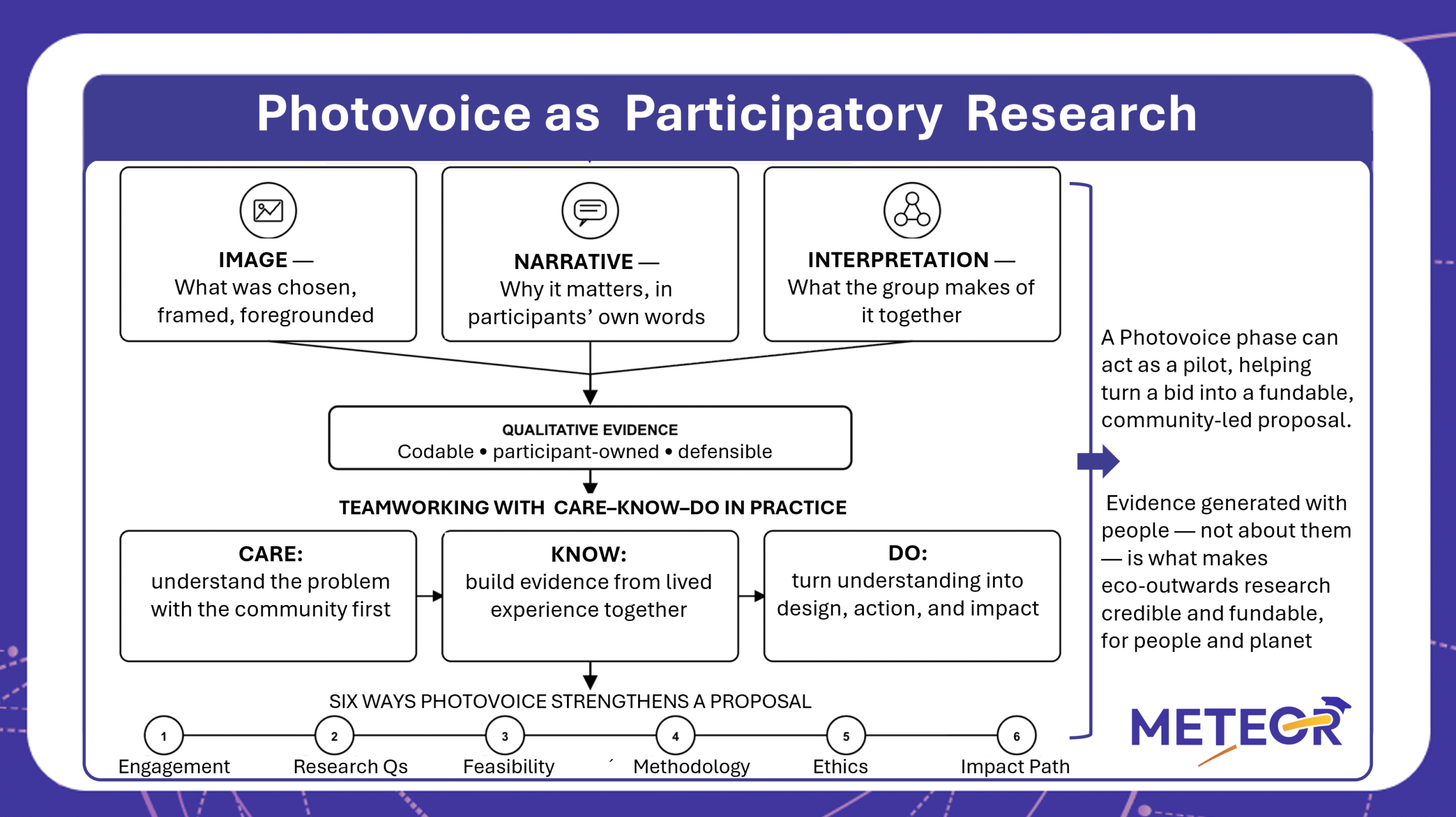
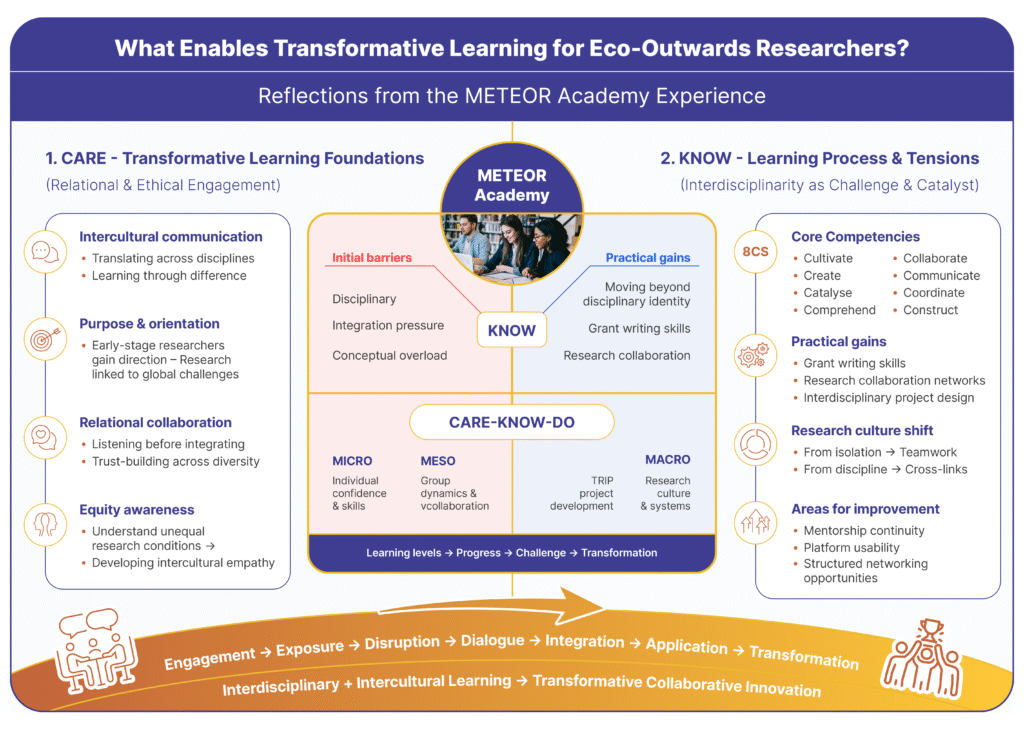
The METEOR Academy is structured around the CARE–KNOW–DO framework, which aims to foster key competencies that contemporary researchers—and the societies they serve—value: advancing knowledge and taking action for societal impact through transformative proposals. CARE–KNOW–DO supports progression from awareness to action in collaborative research, emphasising CARE (ethical and societal responsibility), KNOW (interdisciplinary understanding), and DO (responsible application). In doing so, it promotes transformative learning that enhances employability and addresses global challenges.
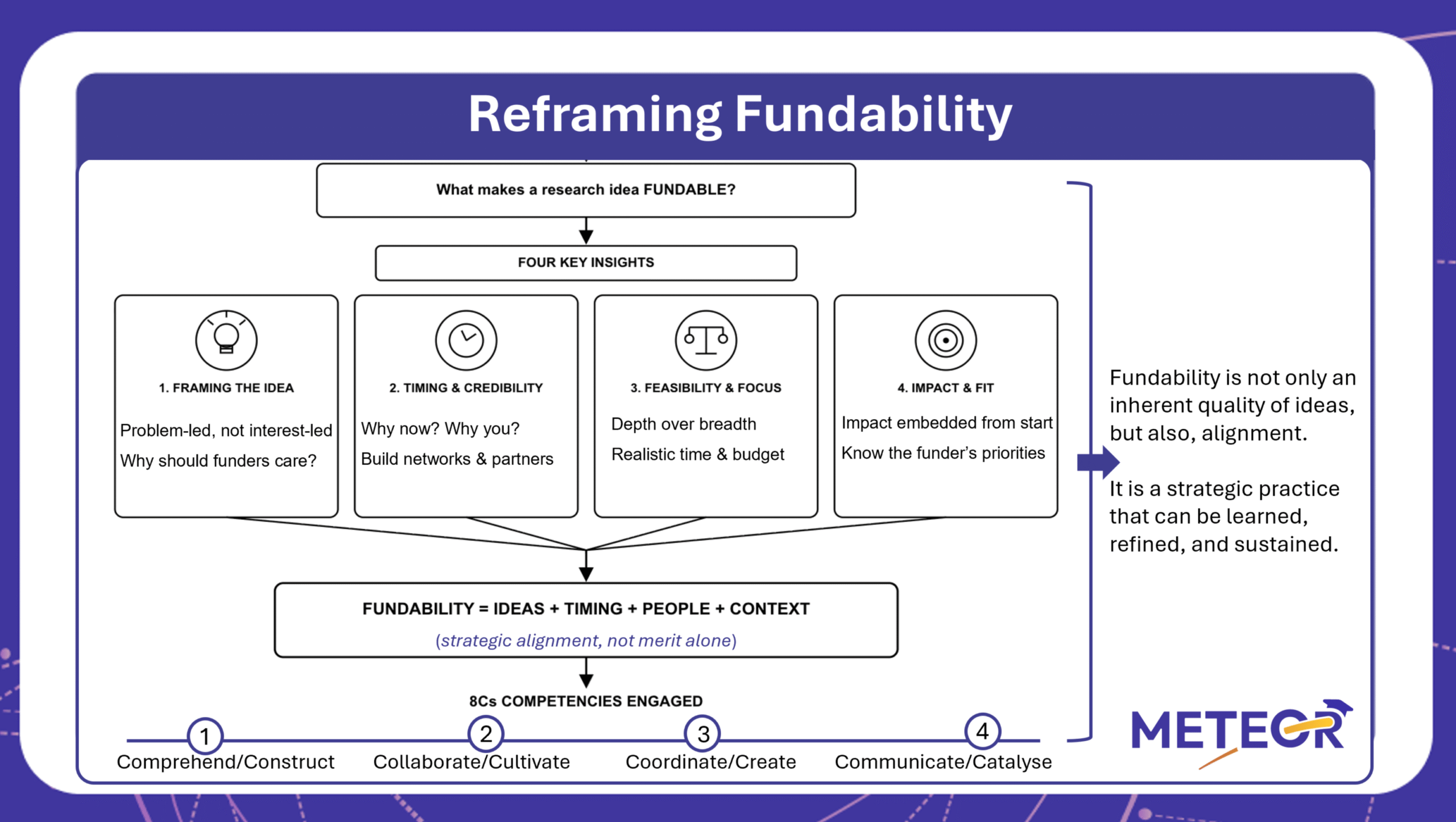
The UK team of ten METEOR members reflected on how the academies strengthened the 8Cs — eight core transversal skills (Okada et al., 2026): collaborate, communicate, cultivate, comprehend, construct, create, coordinate, and catalyse — while allowing for variation across cultures, disciplines, and contexts. Members attended a five-day programme delivered with a shared structure adapted to different host locations: Cyprus, Denmark, Finland, Spain, and Türkiye. The UK group included early career and postdoctoral researchers, alongside doctoral students at different stages — from first-year candidates to those nearing completion — many of whom were balancing their studies with full- or part-time professional roles across different sectors. At each academy, they joined approximately fifty attendees drawn from the wider METEOR consortium of twelve partner institutions across Europe and Brazil. This diversity was not incidental but central to what the Academy made possible and to what the participants describe as follows.
2.1 Transformative proposals: Communicate and Coordinate
A key component was the collaborative teamwork through which participants practised their Communication and Coordination skills across academy activities, supported by METEOR mentors and coordinators working with peers from different countries.
Communication across disciplinary and cross-national boundaries emerged as the most immediately transformative competency for many participants. Explaining one’s research to peers from entirely different fields—initially challenging—became a productive site of learning, as participants were required to translate complex ideas into more accessible forms and engage with unfamiliar perspectives. A second-year PhD student in STEM reflected on her experience in Türkiye: “When you’re on the other side and you have to submit a grant and you don’t even know the format; it’s a very overstimulating experience. So, I thought it was very nice of the host academies to at least show you what the format looks like, how much detail you need to put in…”
For doctoral students earlier in their journeys, the academy provided something equally important: a sense of coordination and direction. A first-year EdD student balancing doctoral study with full-time work as an Early Childhood educator described how her learning in Spain reframed her relationship to her research: “It really opens it up and, in a way, made it easier, because it’s more of a purpose—an overarching kind of this is what we aim to do—that could impact global education or global goals.”
2.2. Interdisciplinarity: comprehend, construct, create and catalyse
The Peer Mentoring Groups (PMGs), each tasked with developing a Transformative Research and Innovation Proposal (TRIP), placed interdisciplinarity at the heart of the academy practice. Groups were deliberately composed of researchers from disparate fields, and the initial reaction was often scepticism. Yet the process of working through that discomfort proved formative. Comprehension was activated by listening to each other. A third-year EdD student in Cyprus described how her group navigated the challenge: “We just had time to listen, first of all, to each other—listening to our skill sets, our experiences. So we had time to kind of connect first of all. And after that, we started thinking about projects and we came up with a project that required the integration of everyone’s skills. The synergy of different skill sets was a beautiful thing to see.”
However, achieving this balance was not straightforward for all groups. A fourth-year EdD student in Spain observed that the expectation of integrating every discipline into a single proposal could paradoxically limit creative ambition, yet ultimately found that discovering unexpected connections—across immigration studies, arts education, AI, and reading for pleasure within a single group— demonstrated that disciplinary boundaries are more permeable than doctoral training typically suggests. Construction from connected fields enabled creation of original projects: “Even though we’re doing different things, there was some kind of way you can integrate them for projects. It was able to integrate to form an idea and I didn’t know that was really possible.”
Where groups reached an impasse, the most productive strategies were those that moved away from disciplinary identity altogether. A postdoc researcher in Denmark, described how her group broke through towards Catalysing the process: “We decided, let’s completely come out of our fields and talk about what is happening in each of our contexts or each of our countries, and then see if there are commonalities from there.” By anchoring the group in shared social concerns rather than disciplinary expertise, common ground became visible—and the proposal followed from there.
2.3. International teamworking: Collaborate and Cultivate
Beyond the group practice, participants highlighted the opportunity to connect with researchers across Europe as distinctively valuable.
A fourth-year PhD student in Spain identified collaboration as one of the most consequential skills practised in the Academy, noting that the relationships built there opened pathways well beyond the immediate experience: “The opportunities I can see from the METEOR project — one is collaboration. You have the opportunity to collaborate with other researchers, which will open up so many opportunities. And the second one is in terms of funding. The skills that you will acquire in the METEOR Academy will go a long way in helping you to apply for funding for your research.” Funding readiness is not itself one of the 8Cs, but the quote points to how the Academy’s competencies — particularly Collaborate, Communicate, and Construct — translate into concrete capabilities such as proposal writing and grant collaboration. This positions the 8Cs as foundations for sustained research careers rather than as ends in themselves.
The motivations to participate were, for several, bound up with a recognition that the doctoral journey is isolating, and the international academy enabled cultivating relationships and expanding research networks. In Spain, a fifth-year EdD student articulated what many echoed: “I saw it as an opportunity to further develop my research skills, particularly in communication, collaboration, and mentorship.”
At the same time, participants also reflected on the value of diversity within the Academy, while suggesting a need for more targeted networking opportunities. An Early Career Researcher in Finland noted that “the Academy activities were well organised and interactive; the diversity of people, countries, disciplines, and roles was rich. However, having more opportunities to interact with researchers from similar fields and roles would be valuable for expanding networks.”
The international composition of the Academy also opened a dimension of intercultural empathy that extended well beyond disciplinary exchange. A postdoctoral researcher in Cyprus reflected on how her group’s diversity revealed the unequal conditions under which research is conducted globally: “It was quite salutary to understand how open-minded our research is at the Open University, compared to the pressures others face due to complex geopolitical contexts and institutional constraints. While we were there, two of the participating universities were under threat of being shut because of the liberal elements of the work they were doing.” Participants were not only learning to collaborate across fields, but coming to understand the vastly different conditions under which their peers pursue knowledge at all.
3. Looking Ahead
Participants were candid about areas needing development. Mentor support had not yet materialised for several groups at the time of the focus group, platform usability led teams to migrate informally to WhatsApp and shared drives, and staggered arrivals disrupted group cohesion in some cases. These are structural issues that an extended academy format is well positioned to address—provided that continuity mechanisms, particularly mentoring, are activated promptly and sustained consistently.
What the METEOR Academy demonstrated, in the words of its participants, is that working across fields, countries, and career stages is not merely enriching but transformative. As one postdoctoral researcher reflected: “METEOR gave me the opportunity to work in a dynamic, intercultural environment where I could learn from peers and international researchers. It challenged my assumptions and helped me think more broadly about research design, ethics, and practice.”
Yet the academic literature has not fully kept pace with such emerging academy models. While experiential formats such as hackathons (Surendran & Mack, 2024) and living labs (Jeffery et al., 2023; Schäpke et al., 2018) are increasingly well theorised, sustained academy-based models for researcher development remain under-examined.
For early career researchers navigating the often-narrow pathways of doctoral education, the Academy offers a rehearsal for the collaborative and interdisciplinary realities of contemporary research practice. By integrating elements of hackathons, summer schools, and living labs, it brings together formats that are often studied in isolation, enabling more integrated forms of researcher development.
Further research is needed to examine how academy models compare with shorter experiential formats in sustaining interdisciplinary collaboration, strengthening research culture, and addressing the structural inequalities that participants in METEOR began to surface.
References:
European Commission (2025) Meteor Project, funded by the European Commission. https://cordis.europa.eu/project/id/101178320?utm_source=chatgpt.com
Cullinane, A., McGregor, D., Frodsham, S., Hillier, J., & Guilfoyle, L. (2022). Transforming a doctoral summer school to an online experience: A response to the COVID‐19 pandemic. British Journal of Educational Technology, 53(3), 558-576.
Jeffery, A., Pringle, J., & Law, A. (2023). Experiential and authentic learning in a Living Lab: The role of a campus-based Living Lab as a teaching and learning environment. Journal of Learning Development in Higher Education, 28. https://doi.org/10.47408/jldhe.vi28.1020
Kolb, D. A. (2014). Experiential learning: Experience as the source of learning and development (2nd ed.). Pearson Education
Healey, M., Flint, A., & Harrington, K. (2014). Engagement through partnership: Students as partners in learning and teaching in higher education.. Advance HE
Okada, Alexandra; Sheehy, Kieron; Rossade, Klaus-Dieter and Bandara, Arosha (2026). Developing Researchers’ Competencies through CARE–KNOW–DO and upSKILL.map, aligned with EU and UNESCO Priorities. Open Research Europe, 5, article no. 333.
Researcher Development Concordat Strategy Group. (2019). Concordat to Support the Career Development of Researchers. Universities UK. https://researcherdevelopmentconcordat.ac.uk/
Surendran, S., & Mack, K. (2024). The use of extracurricular hackathons to promote and enhance students’ academic and employability skills. International Journal of Educational Research Open, 5, 100279. https://doi.org/10.1016/j.ijedro.2023.100279
Vitae. (2025). Researcher Development Framework (RDF 2025). Careers Research and Advisory Centre (CRAC). https://vitae.ac.uk/vitae-researcher-development-framework/
Note: This article is contributing to the WP5 Deliverable about the evaluation of the first METEOR Academies. Reference: [upcoming]
Authors: Alexandra Okada, Jane Doka, Maham Hayat, Hannah Payne, Stephanie Akinwoya, Portia Dery, Louis Dawuda, Felicia Boateng, Melissa Bailey, and Melisa Porter.
Author Contributions (CRediT): AO contributed to Conceptualization, Formal analysis, Visualization, and Writing – Original Draft. JD contributed to the investigation. All authors contributed to Data Generation, Data Analysis, and Writing – Review & Editing.
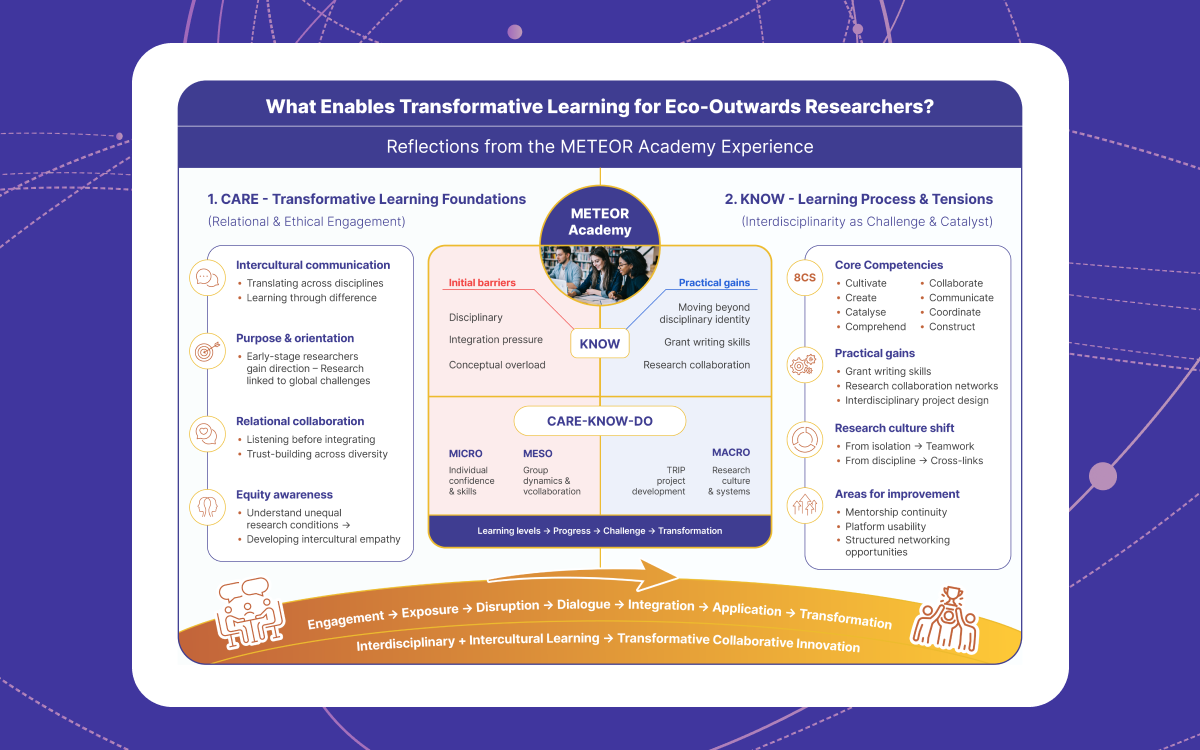
Generative AI tools declaration. ChatGPT (GPT-4o, OpenAI) was used for proofreading and language editing of author-drafted text. GPT-4o image generation (OpenAI) produced the graphical abstract through iterative prompting, refined in Adobe Photoshop. Claude (Anthropic) supported the revision of the 8Cs thematic deductive analysis within the CARE–KNOW–DO framework. All outputs were reviewed and verified by the authors, who take full responsibility for the manuscript.
Citation: Okada A, Doka J, Hayat M, Payne H, Akinwoya S, Dery P, Dawuda L, Boateng F, Bailey M, and Porter M. Reflections on Transformative Learning for Eco-Outwards Researchers. Published by METEOR – Methodologies for Teamworking in Eco-Outwards Research. CC BY-SA 4.0.
Links
Meteor Video News (2026). Academies Snapshots in Linkedin URL
Keywords
Meteor Academies, 8Cs, Care-Know-Do, Eco-Outwards Researcher, Transformative Learning
Acknowledgements
Quotations throughout this article are presented with role and host academy only, in keeping with the focus-group protocol under which they were collected. The co-authors include UK METEOR Academy participants whose reflections inform the analysis.
We are grateful to our external peer reviewers, including Jan Bazyli Klaka and Leyla Kamyabi, for their thoughtful feedback.