From Idea to Funding: What Really Makes the Difference?
This article reflects on a METEOR Online Café discussion on what makes research ideas fundable. It argues that successful proposals rest less on intellectual merit than on the strategic alignment of ideas, timing, people, and context — and draws out what this means for early career researchers navigating competitive funding landscapes.
The METEOR Online Café brought together twelve researchers from different nations, including the UK, Brazil, Botswana, Sri Lanka, India, Jamaica, and Zimbabwe, to explore a persistent challenge in academic life: how research ideas evolve into fundable projects. While success in research funding is often attributed to originality or intellectual merit, the discussion revealed a more complex reality. Fundability is not an inherent quality of an idea alone; rather, it emerges through the strategic alignment of research visions with people, partnerships, timing, priorities, and the wider academic, policy, and institutional ecosystems in which funding decisions are made.
Participants represented diverse fields including:
- Global Development Studies
- Global Education and Digital Transformation
- Inclusive Education and Teacher Training
- Science, Technology and Innovation Studies
- Inclusive Health Systems and Public Policy
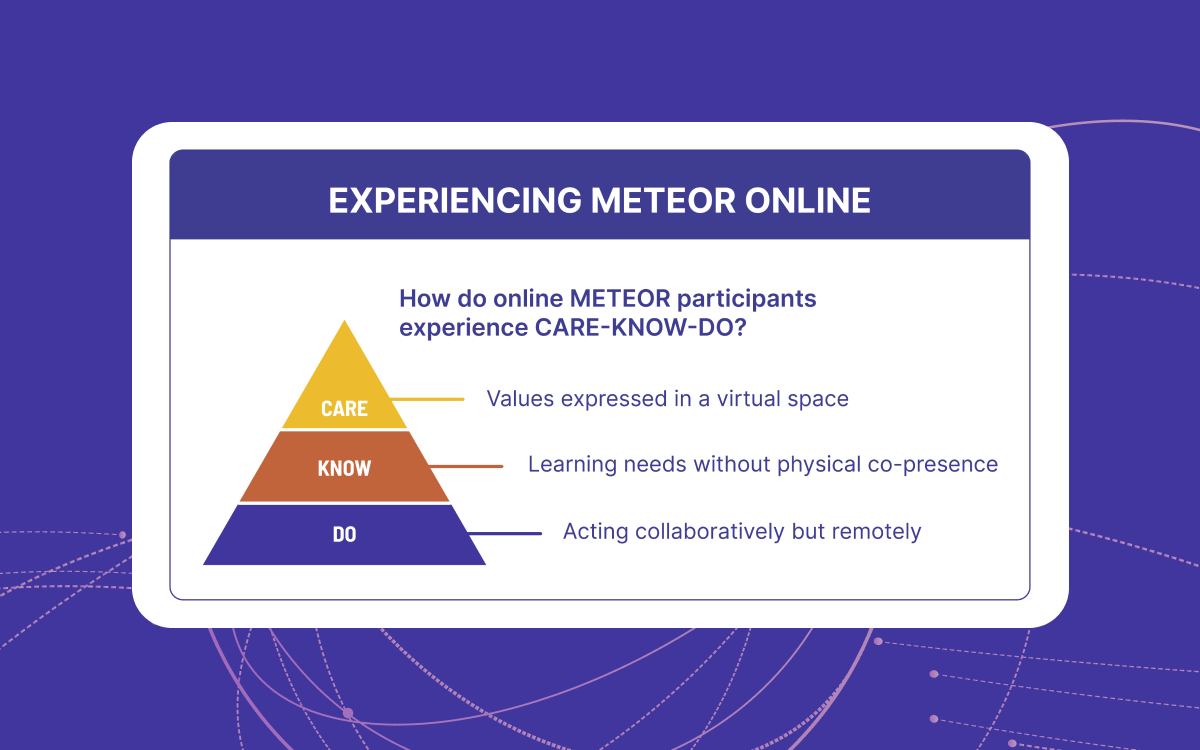
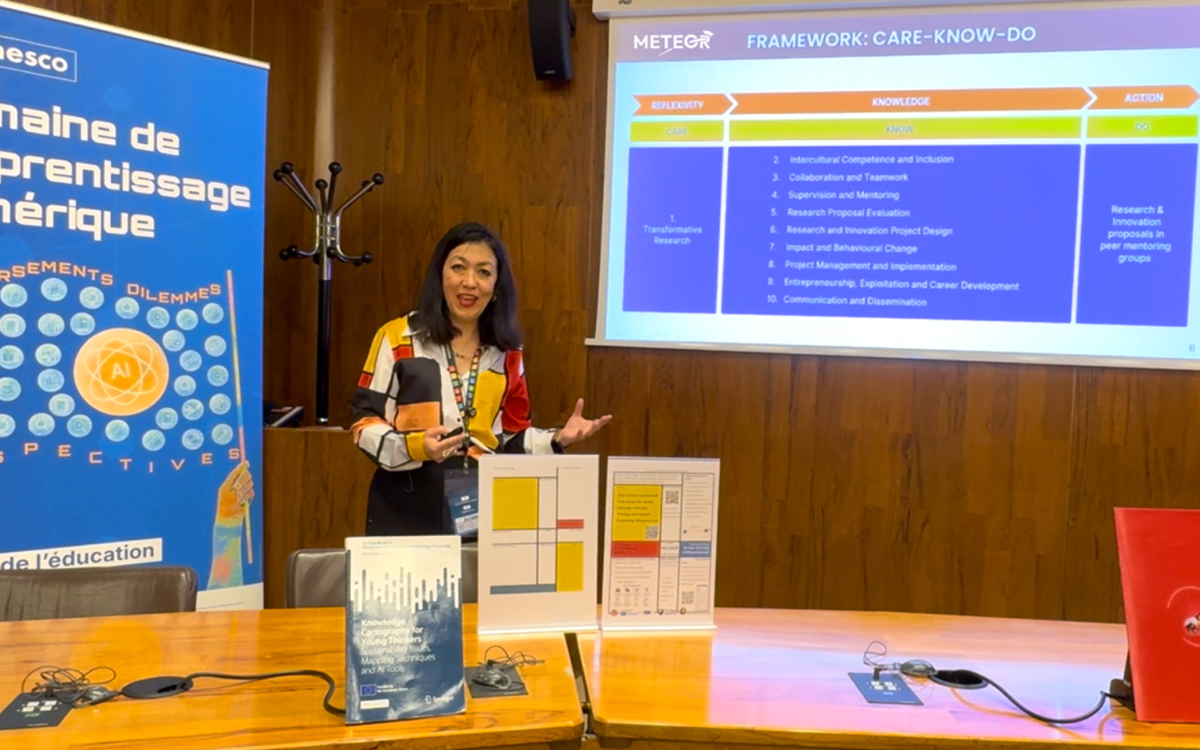
Drawing on insights from invited speaker Jennifer Agbaire, alongside participant reflections, this article explores what differentiates a ‘good idea’ from a ‘fundable idea’ and considers the implications for ECRs navigating competitive funding landscapes. In doing so, it connects these insights to METEOR’s emphasis on transversal competencies, particularly Collaborating, Constructing, and Catalysing within the 8Cs framework (Okada et al., 2026).
From Good Ideas to Fundable Ideas
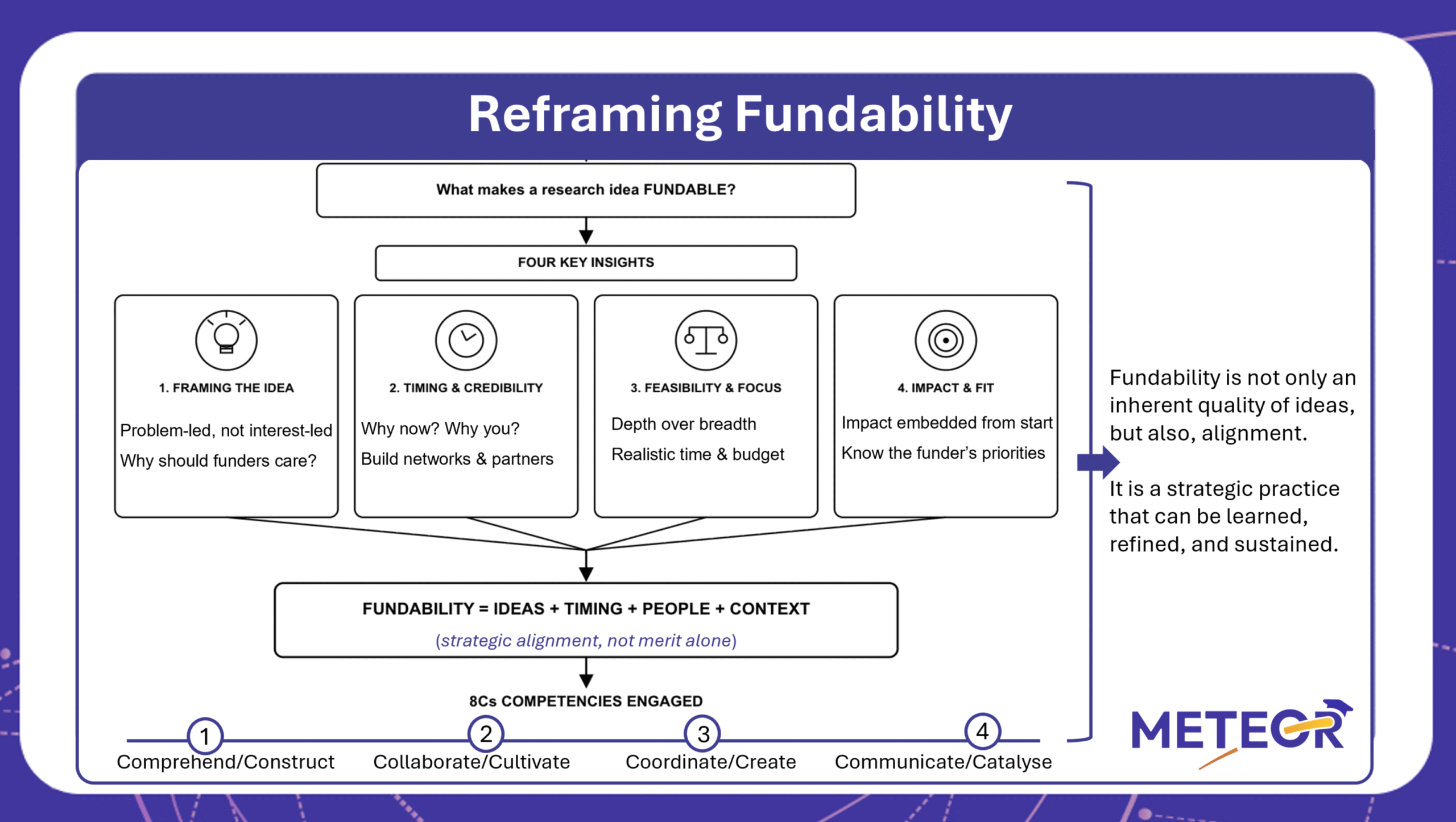
A defining insight from the session was the distinction between intellectually interesting ideas and fundable proposals. This distinction reorients the starting point of proposal design. Rather than centring personal curiosity, researchers must frame their ideas as responses to identifiable problems.
“One of the biggest misconceptions is that good ideas get funded. That’s not always true. What gets funded is fundable ideas… Funders are not necessarily interested in your interest; they are interested in why anyone should care about that interest.” – Jennifer Agbaire
This shift reflects a movement away from researcher-centred thinking towards system-oriented framing. What matters is not only what the researcher finds compelling, but how convincingly the problem is articulated in relation to broader societal, policy, or practice challenges. For many ECRs, this distinction between an interesting idea and a fundable idea can feel uncomfortable because doctoral training often encourages researchers to begin with questions that genuinely interest them. As one participant noted:
“Jennifer, that’s a very painful thing to say to me as an ECR, because I like to say, ‘I’m interested in this’ because that’s what I care about!” – Jane Doka
Although expressed light-heartedly, the comment resonated with a common academic instinct: to begin with what fascinates us. The challenge, however, is learning how to translate that fascination into a compelling case for why others, including funders, should care. Participants recognised this as a recurring challenge in their own experience. As one reflected, proposal feedback often centres on framing.
“I think framing of the issues is one thing that I found particularly challenging because, you know, if so, I have written some grants. for in last couple of years. So usually, feedback that I get sometimes is this is not how you should frame it.” – Pallavi Joshi
This aligns with METEOR’s Constructing competency, where research is not simply generated, but strategically articulated to demonstrate relevance and significance beyond the individual researcher.
Timing and Credibility: The “Why Now?” and “Why You?” Question
The discussion highlighted that funding decisions are shaped not only by the strength of an idea, but by a dual alignment: why the idea matters at this moment, and why the applicant is best placed to deliver it. These two questions, often treated separately, operate together at the core of fundability.
Timing emerged as a critical but often overlooked factor. Even strong proposals may struggle if they are misaligned with current priorities. Funders operate within shifting landscapes shaped by policy reform, global challenges, and strategic agendas. This means that the same idea may be perceived very differently depending on when it is proposed. When a research problem aligns with a moment of urgency, such as policy change or emerging societal concern, it can shift from being intellectually interesting to strategically compelling. Fundability, therefore, is not only about relevance, but about temporal alignment with opportunity.
At the same time, timing alone is insufficient without credibility. Funders are not simply evaluating ideas in isolation; they are also assessing whether applicants can realistically deliver them. This introduces a competitive dimension in which applicants must differentiate themselves among equally capable peers. As she further emphasised:
“Funders are funding people as well as ideas. They want confidence that you can actually deliver. In a competitive funding landscape, you are not simply looking to show that you are capable, you are looking to show that you might be more capable than others who are capable as well.” – Jennifer Agbaire
For ECRs, this dual expectation, demonstrating both timeliness and credibility, can be particularly challenging. Participants recognised that building networks and collaborations is essential to strengthening this position.
“It then follows that it’s more critical to actually build our network before the issue of submitting a funding project.” – Jane Doka
“You need to think strategically about what you bring and what you lack. And how can you pitch that to somebody else that can bring something else” – Jennifer Agbaire
This highlights that “Why you?” is rarely answered alone but it is often addressed through partnerships that complement expertise, extend access, and strengthen feasibility. In this sense, timing and credibility intersect, i.e., a well-timed idea requires a team that can convincingly act on that timing.
Within METEOR, this combined challenge draws on both the Comprehending competency i.e., understanding the wider research and policy context, and the Collaborating competency and building the networks necessary to respond effectively. Recognising when an idea becomes fundable and positioning oneself (or one’s team) to deliver it, are therefore inseparable aspects of successful proposal development.
Feasibility, Scope, and the Risk of Over-Ambition
A further theme concerned the balance between ambition and feasibility – a tension that is particularly pronounced for ECRs. Many feel pressure to demonstrate scale, innovation, and wide-ranging impact in order to be competitive. However, this tendency to ‘do more’ can inadvertently undermine credibility if the proposed project appears unrealistic within the given time, budget, and resources. Many participants resonated with reviewers’ feedback such as:
“This is such a great idea, but it is overly ambitious… a polite way of saying you cannot realistically deliver it.” – Jennifer Agbaire
This type of feedback reveals an important principle: fundability is not about scale for its own sake, but about the credibility of delivery. Reviewers are not simply assessing whether a project is exciting, but whether it is doable. Overly complex designs – spanning too many countries, methods, or objectives – can signal a lack of strategic focus rather than strength. In practice, this means that successful proposals often prioritise depth over breadth. A focused, clearly defined project that can be executed with rigour is typically more convincing than a large, multi-layered proposal that stretches capacity. Funders are more likely to invest in work that demonstrates careful design, realistic timelines, and proportional use of resources.
“It’s not about doing more; it’s about doing enough well.” – Jennifer Agbaire
Participants connected this insight to their own experiences of writing proposals, highlighting the difficulty of calibrating ambition. On the one hand, proposals must signal significance and potential; on the other, they must remain grounded in what is achievable. This balancing act requires not only methodological clarity, but strategic judgement about scope i.e., what to include, what to postpone, and what to develop in future stages. Importantly, this does not mean abandoning ambitious research agendas. Participants reflected that this involves staging ambition over time.
“Sometimes it is best to use smaller or more focused projects as building blocks toward larger programmes of work” – Pallavi Joshi
Participants also questioned common assumptions about scale in funded research, particularly for qualitative researchers.
“One of the things that we find is we’re constantly told funders are interested in quantity, the number of participants or the size of the impact. For many people who do qualitative research and smaller samples, that might be something to think about.” – Jane Doka
This observation highlights an ongoing challenge for researchers working with in-depth qualitative approaches: demonstrating significance and impact without relying primarily on numerical scale. In this sense, feasibility becomes part of a longer-term research trajectory rather than a limitation. This balance reflects METEOR’s Coordinating competency, which emphasises the ability to design coherent, manageable research plans. Coordinating effectively involves aligning aims, methods, timelines, and resources in a way that demonstrates not only what the research seeks to achieve, but how it will realistically get there.
Designing for Impact and Finding the Right Fit
Taen together, the insights presented in this discussion point to broader implications for how ECRs approach funding. A key insight from the discussion was that impact and funder alignment are not separate considerations, but deeply interconnected elements of fundability. Strong proposals do not only demonstrate what a project will achieve, they show how those achievements align with the priorities, expectations, and strategic vision of a specific funder. Impact, in this sense, is no longer treated as something that happens at the end of a project. Instead, it must be embedded from the outset as part of the design.
“Funders increasingly want impact built in from the start. It’s increasingly not enough to say findings will reach academics…who else? why would they use the findings, and how?” – Jennifer Agbaire
This requires a shift away from generic statements about dissemination towards more thoughtful engagement with how research will actually be used. Designing for impact therefore involves anticipating users, contexts, and pathways of influence. It requires asking not only what knowledge will be produced, but who will benefit, how they will access it, and what change it might enable. Importantly, these considerations must be grounded in context. For instance, assumptions about digital dissemination may not hold in resource-constrained settings, illustrating that impact strategies must be tailored rather than assumed.
At the same time, the effectiveness of an impact plan depends on how well it aligns with the priorities of the funding body.
“It’s about finding the right fit. The fit is really quite important in what you are trying to do” – Jennifer Agbaire
This highlights that funders have distinct identities, expectations, and patterns of what they support, not only in terms of topics, but in how research is framed, delivered, and translated into impact. A proposal may be strong in isolation, but still unsuccessful if it does not resonate with the funder’s broader agenda.
Participants noted the importance of developing a deeper understanding of funders beyond the surface level of calls. This includes reviewing previously funded projects, analysing how ideas are articulated, and identifying implicit priorities. In this sense, impact design becomes inseparable from funder alignment: demonstrating impact is also a way of demonstrating fit.
Engaging with funders through briefings, webinars, and direct communication can provide critical insight into expectations that are not always visible in written calls. Fundability, therefore, is not only about interpretation but about active engagement and strategic positioning. Impact is not simply an output requirement, and fit is not merely administrative; together, they shape how research is imagined, designed, and ultimately supported.
Implications for ECRs and METEOR
Across the discussion, fundability emerged as a multi-dimensional process requiring integration of intellectual, strategic, and relational competencies. ECRs are not only expected to generate ideas, but to:
- Frame problems convincingly
- Align with timely priorities
- Build networks and credibility
- Design feasible and focused projects
- Embed meaningful pathways to impact
Participants reflected that this requires a shift in mindset, from reactive applications to strategic development. One participant highlighted:
“Sometimes we think linearly and look for calls and then fit in retro, fit your ideas to it. So it’s very useful thinking about it in a very different way” – Pallavi Joshi
Rejection was also reframed as a normal and valuable part of the process. As Agbaire emphasised:
“You can submit a very strong application and still not be funded… don’t internalise every rejection as a personal failure.” – Jennifer Agbaire
Comments shared in the chat highlighted the importance of using peer-reviewers’ feedback to enhance the proposal. This perspective positions feedback and iteration as central to learning, aligning with METEOR’s broader emphasis on developing research capabilities over time supported by expert mentors. Participants were reminded that the METEOR (2026) resources contain useful materials for proposal development.
Conclusion: Reframing Fundability
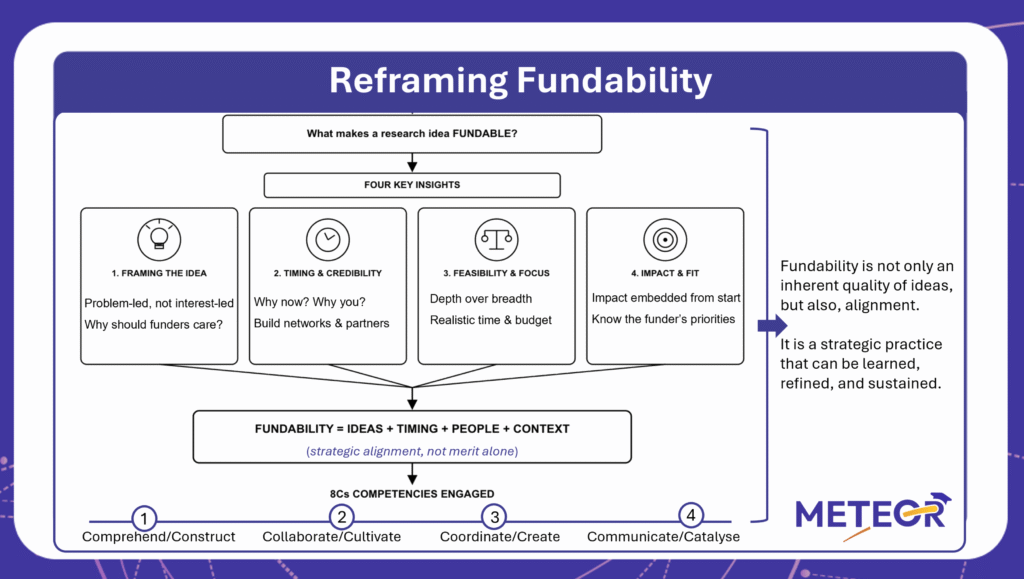
The METEOR Online Café offers a clear conclusion: fundability is not an inherent property of ideas, but the result of strategic alignment between ideas, timing, people, and context.
By moving beyond the assumption that “good ideas get funded,” researchers can better engage with the realities of funding systems. In doing so, they develop not only stronger proposals, but also the broader competencies essential for thriving in contemporary research environments.
For METEOR participants, these insights reinforce the importance of cultivating transversal skills that enable researchers to construct meaningful ideas, collaborate effectively, coordinate realistic plans, and catalyse impact (Okada et al., 2026). Fundability, in this sense, becomes not merely an outcome, but a practice that can be learned, refined, and sustained over time—transforming individual projects into coherent programmes of research that generate lasting scientific, societal, and policy impact (Okada & Gray, 2023). Ultimately, successful research funding depends not only on the quality of an idea, but on researchers’ capacity to align vision, collaboration, and strategy to create meaningful and sustainable change.
Authors: Jennifer Agbaire (Invited Speaker); Jane Doka (Interlocutor); Alexandra Okada (Chat Moderator); Pallavi Joshi (Participant Collaborator)
Author Contributions (CRediT): JA contributed to the main presentation as an invited speaker and to the revision of the transcript, summary notes, and final version. JD moderated the session, developed the full draft based on the summary notes and transcript, and contributed to the formal analysis and writing of the original draft. AO prepared the summary notes, facilitated and synthesised the chat discussion, contributed to writing – review and editing, and finalised the manuscript, including typesetting and graphical visualisation. PJ contributed to data production, as well as the final review and proofreading of the manuscript. All authors approved the final manuscript and agreed to the inclusion of attributed quotes from their contributions.
Citation: Agbaire J.; Doka J.; Okada A; Pallavi J. (2026). From Idea to Funding: What Really Makes the Difference? Published by METEOR – Methodologies for Teamworking in Eco-Outwards Research. CC BY-SA 4.0.
Use of AI: AI was used for transcription, synthesis and proofreading.
Keywords
Online doctoral collaboration, CARE–KNOW–DO framework, Transversal researcher skills, Fundability, Inclusive research practices
Acknowledgements
We are grateful to all participants in the METEOR project for their valuable contributions, and to our peer reviewers for their generous and insightful feedback.
References
METEOR (2026). Methodologies for teamworking in Eco-outwards Research. Available at: https://www.meteorhorizon.eu/meteor-programme/.
Okada, A., Sheehy, K., Rossade, K.D. and Bandara, A.K., 2026. Developing Researchers’ Competencies through CARE–KNOW–DO and upSKILL. Map, aligned with EU and UNESCO Priorities. Open Research Europe, 5(333), p.333.
Okada, A., & Gray, P. (2023). A climate change and sustainability education movement: Networks, open schooling, and the ‘CARE-KNOW-DO’framework. Sustainability, 15(3), 2356.