How Photovoice Turns Lived Experience into Qualitative Evidence — and Why That Matters for Eco-Outwards Research Teams
Strong research proposals rarely fail for lack of a good idea. More often, what undermines them is a narrower gap: between what a team claims a community needs, and what it can demonstrate having built with that community. METEOR’s premise is that credible eco-outwards research — research that turns outward toward communities and the ecologies they live in — is built by teams who generate that evidence with people, not about them.
A newly published resource from The Open University, the Photovoice Handbook (Ebubedike, Akanji, Mala and Afu, 2026), offers a practical route to exactly that, and it carries a quieter lesson too: a well-run participatory method is also a proposal-development engine.
What Photovoice Does That Questionnaires Cannot
The handbook draws on Photovoice research conducted with communities — and especially with children and young people — living through protracted armed conflict and crisis across the Lake Chad region, spanning Nigeria, Niger, Chad and Cameroon, with support from the Academies and the Global Challenges Research Fund. Its starting point is a hard truth for anyone designing research in fragile settings: where lives are shaped by insecurity, displacement, poverty and trauma, conventional methods tend to miss the very things that matter most — the lived experience, situated knowledge and agency that communities already hold.
“The experiences of those who matter in the research are often excluded… Photovoice helps us centre on the people, on the communities, on those who are the heart of the research.” — Ebubedike
“There is something more tangible to hold on to, to speak and to voice and to share narratives around a person’s experience when through a photograph rather than just talking into the space. The stories help unlock new perspectives and a holistic understanding of the situation.” — Ramamoorthi
Photovoice answers that by handing the camera over. Participants photograph what is significant in their own lives, then narrate those images in their own words, placing their voice at the centre of the inquiry. The result is not decoration around a dataset; it is the data — visual and narrative evidence that lets participants shape knowledge production and feed directly into co-creating locally relevant, resilient and inclusive responses.
From Images to Qualitative Evidence
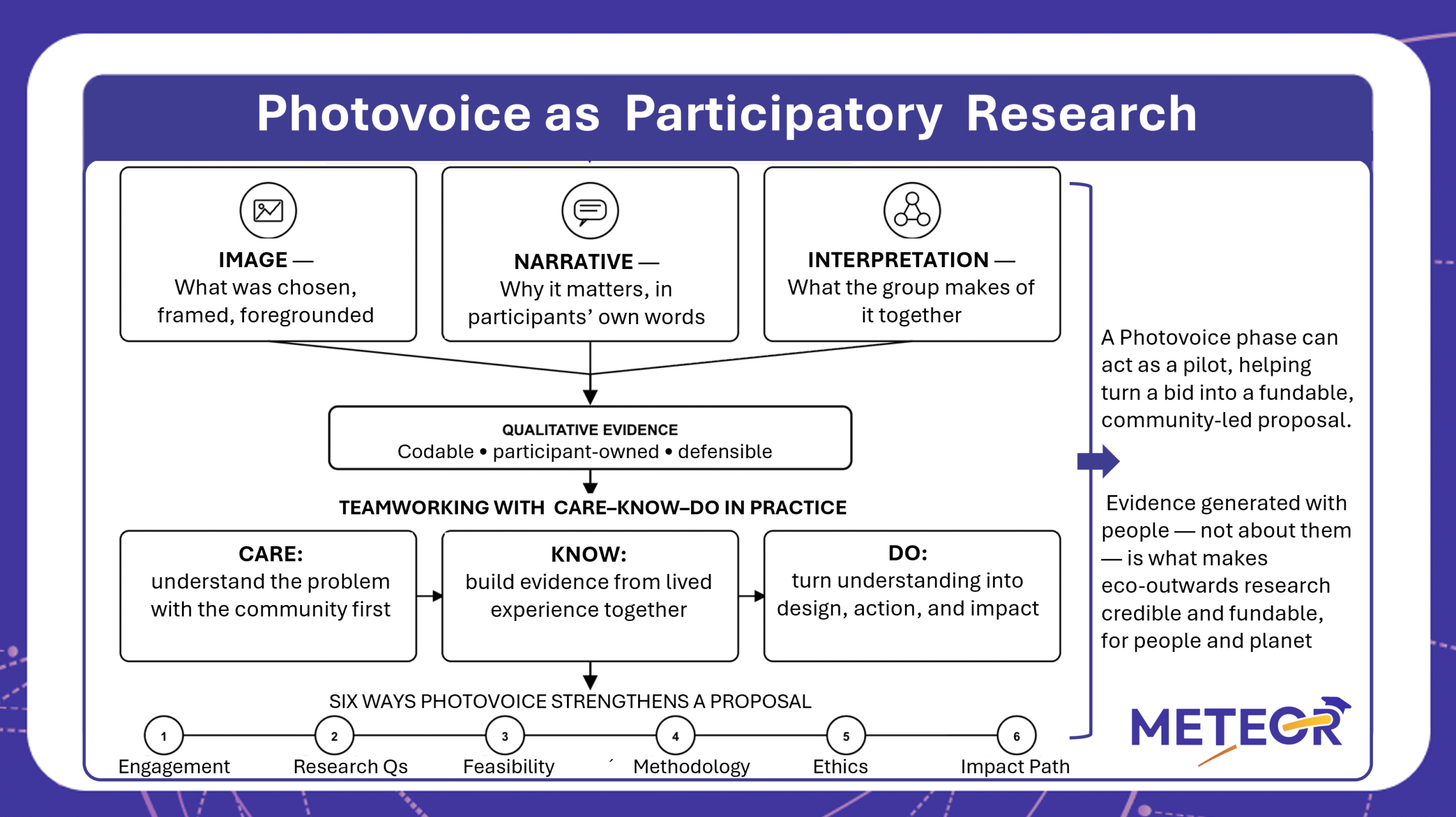
For a research team, the methodological value is concrete. Each photograph, paired with its caption and the dialogue around it, produces a layered qualitative record: an image (what was chosen, framed, foregrounded), a narrative (why it matters), and a collective interpretation (what the group makes of it together). That material is codeable, themeable and traceable to the person who produced it — which means it withstands the analytic scrutiny that funders and reviewers apply to qualitative claims.
Crucially, it is evidence that is owned. Because participants author both the image and its meaning, the data resists the extractive pattern in which outsiders arrive, gather and leave. For eco-outwards teams, that ownership is not only an ethical good; it is what makes the resulting evidence defensible.
This dynamic played out vividly when a photograph taken by a 13-year-old girl from the Lake Chad region was shared in a METEOR Online Café, and participants offered markedly different interpretations of it — a moment discussed in full under Question 2 below, where it directly informed the group’s thinking on who holds the power to interpret participatory images.
The Connection to Proposal Development
This is where Photovoice and proposal-writing meet — and the link is more direct than it first appears. A research proposal that embeds qualitative data is markedly stronger than one that promises to collect it later. Photovoice can supply that grounding across almost every section a reviewer reads:
- Framing the problem. Photovoice imagery gives a needs case rooted in lived reality rather than secondary statistics. A single participant-authored image of a flooded route to school says more about access than a paragraph of literature.
- Generating research questions. Themes that emerge from participants’ own framing become the questions the proposal sets out to answer — questions a funder can see are grounded, not guessed.
- Demonstrating feasibility and trust. A prior Photovoice engagement is hard evidence of access, relationships and a working partnership — the track record reviewers look for, especially when the proposed participants are vulnerable.
- Justifying methodology. Citing a tested, documented instrument (handbook in hand) shows a team that knows how to do participatory qualitative work rigorously, with the protocols already in place.
- Anchoring ethics and safeguarding. Working visually with children in crisis settings forces a mature ethics design — consent, image rights, anonymity, do-no-harm — which a proposal can present as already considered rather than aspirational.
- Building the impact pathway. Because Photovoice ends in co-created responses, the line from evidence to locally relevant action is already visible, giving the impact section a credible, community-led spine.
In short, a Photovoice phase can serve as the pilot that de-risks a larger bid: it produces preliminary qualitative findings, proves the partnership, and rehearses the analysis — all before the full proposal is submitted.
Photovoice as a Teamworking Method
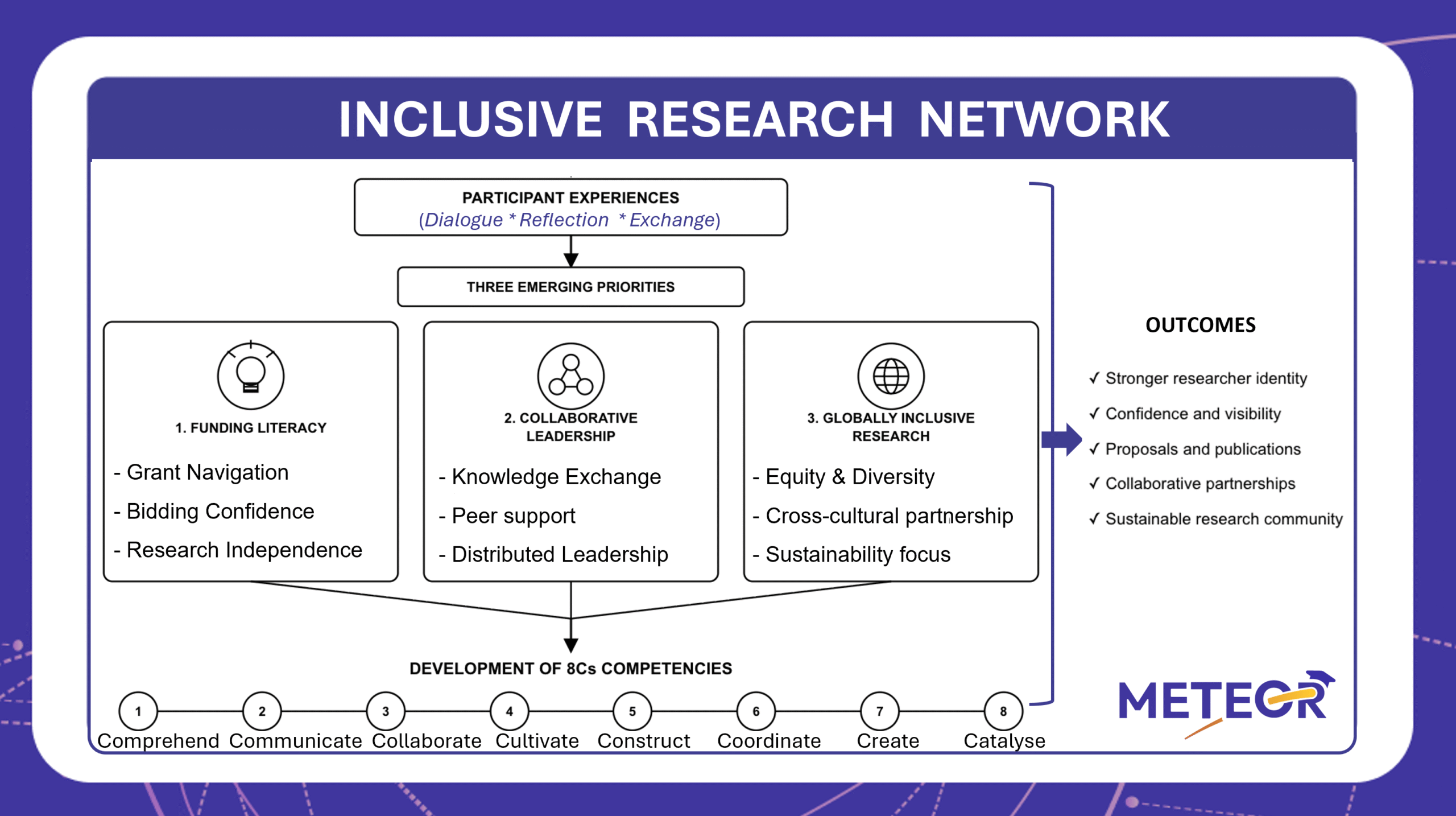
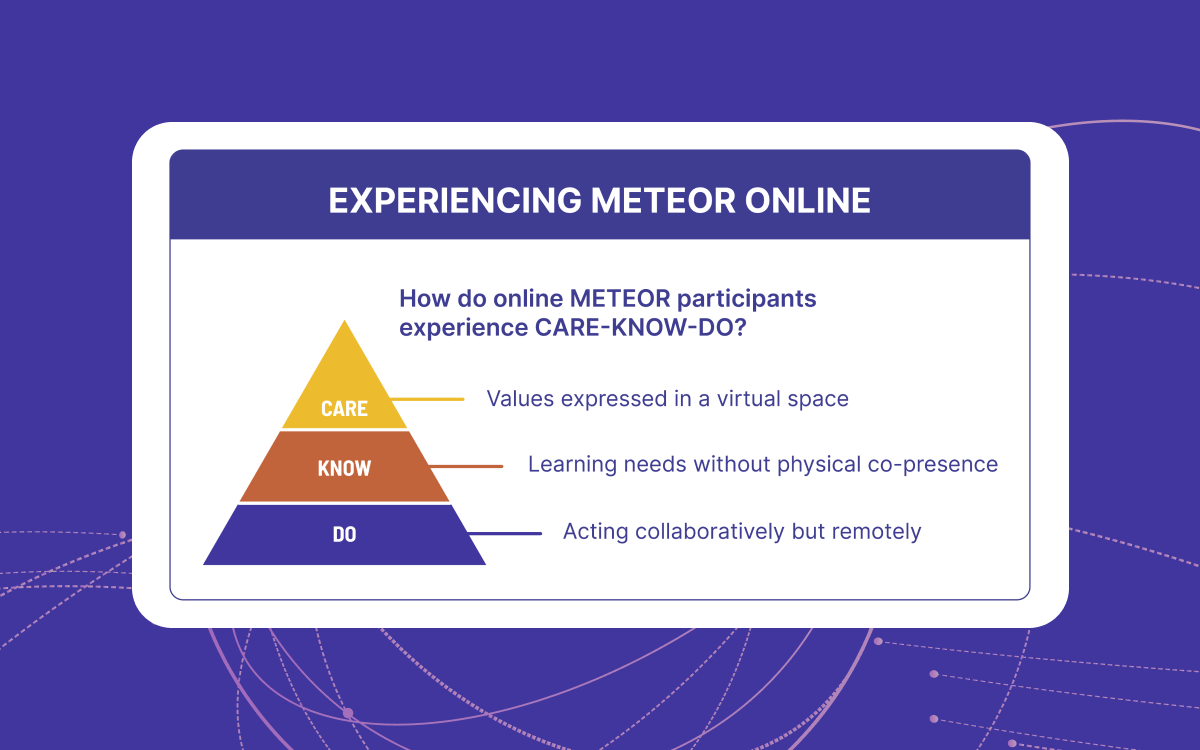
METEOR’s emphasis is on teamworking, and Photovoice is unusually well suited to it. Roles distribute naturally: community members and young people act as co-researchers and image authors; local partners convene and translate; academic team members facilitate analysis and member-check interpretations back with participants. Knowledge is built collaboratively and validated by the people it concerns — the same logic that runs through the CARE–KNOW–DO approach underpinning METEOR (EU Horizon Europe, 101178826): CARE for a real, situated issue, KNOW built from lived experience and evidence, DO as agency exercised in co-creating the response.
Read this way, the Photovoice Handbook is not only a field guide for a single method. It is a template for how an eco-outwards team can move from first contact to publishable qualitative evidence, to a fundable proposal — keeping the community’s voice load-bearing at every step.
Key Questions from the Facilitator That Shaped Discussion in a Recent METEOR Online Café (MOC)
The discussion was framed by a series of probing questions from the facilitator and participants. Rather than treating Photovoice as simply a data collection technique, the questions encouraged examination of deeper issues of ownership, interpretation and inclusion that sit behind all participatory research. Reflecting on her own visual research experience using Photovoice in research on girls’ education in Zimbabwe (see Doka, 2024), the facilitator asked a question that other participants also wanted answered:
Question 1: “Is photo elicitation the same as Photovoice?” — Doka
The question prompted an important methodological clarification from Ebubedike. While acknowledging the similarities between the two approaches, she explained that their primary purposes differ. Whereas photo elicitation uses photographs to stimulate discussion and reflection, Photovoice is explicitly designed to place participants at the centre of knowledge production and meaning-making. Ebubedike explained:
“The primary purpose of Photovoice is to empower participants … to document and communicate their lived experiences and to share their stories. Participants in Photovoice are co-creators of the knowledge and they often help analyse and disseminate the findings.” — Ebubedike
In Photovoice, participants are not simply data sources but active partners in the research process. This distinction matters for eco-outwards research teams: both methods use visual images to deepen understanding, but Photovoice extends participation beyond data collection by positioning participants as researchers of their own realities. The method therefore aligns strongly with METEOR’s commitment to co-production, community-centred knowledge generation and collaborative teamworking.
Question 2: “Who owns the interpretation of those pictures? Who holds the power of interpreting those pictures?” — Doka
This question became particularly relevant during the discussion of a photograph taken by a 13-year-old girl from the Lake Chad region. Participants interpreted the image in markedly different ways:
“Education despite the odds.” — Stephanie “Concentration, quieter times — making the most of a quiet, shady corner to work.” — Jennifer “Out-of-school girls trying to continue learning.” — Dennis “Agency and access to knowledge.” — Ren “Resilience against all odds.” — Doka
Ebubedike used the exercise to demonstrate that while researchers and audiences inevitably view images through their own lenses, the participant who took the photograph remains closest to its intended meaning. She explained:
“Everybody described it from the lens with which they see it. The young photographer explained that the image represented the determination of children to continue learning despite conflict and insecurity. She said, ‘the jihadists might have taken away everything that belongs to the community, but they haven’t taken away their fight.'” — Ebubedike
She described the photograph as illustrating a child who continues striving towards education despite experiencing crisis, displacement and uncertainty. The discussion reinforced a central principle of Photovoice: participants are not merely sources of data but interpreters and authors of knowledge.
Question 3: “I think we might need to interrogate the issue of inclusive research a bit further. As researchers we make a lot of claims to being inclusive and we think we are being inclusive, but are we really being inclusive?”
This question speaks directly to a challenge facing many collaborative and eco-outwards research initiatives, and development projects. Inclusion is often presented as an outcome of participatory methods, yet the session repeatedly highlighted the structural barriers that continue to shape whose knowledge is recognised, whose voices are heard and whose participation is enabled. Reflecting on the resilience and agency demonstrated by the children involved in the Lake Chad project, Ebubedike cautioned against assumptions that researchers are somehow “giving voice” to communities:
“Communities understand their ways of knowing and doing. Yes, Boko Haram has destroyed school buildings, abducted girls and made them jihadist brides. Communities are scared; parents are scared of taking their daughters to school. Yet in the middle of it, there’s a story, there’s a narrative that is not emerging — the resilience of a child. This child is sitting in the middle of the chaos, the crisis, the hunger, the poverty and everything, but she is still striving… All that these communities are asking is that initiatives strengthen what is already happening rather than painting that narrative of deficit that nothing is happening… You don’t give voice to people who are already speaking.” — Ebubedike
Instead, she argued that communities already possess knowledge, expertise and ways of understanding their own realities. The responsibility of researchers is not to speak for them, but to create conditions in which those perspectives can be heard, documented and acted upon — and Photovoice is a critical tool for that process.
Key Takeaways
- Qualitative data is a proposal asset, not an afterthought. Embedding it before submission strengthens the case for need, the research questions, and the impact pathway.
- Photovoice generates ownable evidence. Participants author both image and meaning, producing codeable qualitative data that resists extractive critique.
- A Photovoice phase de-risks a bid. It doubles as a pilot — preliminary findings, proven access, rehearsed analysis, and a mature ethics design already in place.
- The method is also a teamworking model. Distributed co-researcher roles and member-checking align directly with METEOR’s eco-outwards, CARE–KNOW–DO logic.
- Hard contexts demand participatory methods. Where conventional research misses lived experience, knowledge and agency, putting the camera in participants’ hands is what makes the evidence real.
Citation: Margaret Ebubedike, Alexandra Okada, Jane Doka and Bhavani Ramamoorthi (2026). How Photovoice Turns Lived Experience into Qualitative Evidence — and Why That Matters for Eco-Outwards Research Teams Published by METEOR – Methodologies for Teamworking in Eco-Outwards Research. CC BY-SA 4.0.
Authors: Margaret Ebubedike, Alexandra Okada, Jane Doka and Bhavani Ramamoorthi
Author Contributions (CRediT): ME contributed to the main presentation as an invited speaker and to revision of the transcript, summary notes, and final manuscript. AO handled the first draft, prepared the summary notes, facilitated and synthesised the chat discussion, and contributed to writing – review & editing, including typesetting and visualization. JD moderated the session, contributed to the original draft supported by the summary notes and transcript, and contributed to formal analysis and writing. BR contributed to data generation and to final review and proofreading of the manuscript. All authors approved the final manuscript and agreed to the inclusion of attributed quotes from their contributions.
Keywords
Online doctoral collaboration, CARE–KNOW–DO framework, Transversal researcher skills, Narrative inquiry, Inclusive research practices
Use of AI: AI was used for transcription, synthesis and proofreading.
Acknowledgements
We are grateful to all participants in the METEOR project for their valuable contributions, and to our peer reviewers for their generous and insightful feedback.
References
Ebubedike, M., Akanji, T., Mala, A. and Afu, I. K. (2026). Photovoice Handbook. The Open University. The underpinning research was conducted across Nigeria, Niger, Chad and Cameroon with support from the Academies and the Global Challenges Research Fund. This reflection is shared as part of METEOR’s work on teamworking methodologies for eco-outwards research.
METEOR (2026). Methodologies for teamworking in Eco-outwards Research. Available at: https://www.meteorhorizon.eu/meteor-programme/.
Okada, A., Sheehy, K., Rossade, K.D. and Bandara, A.K., 2026. Developing Researchers’ Competencies through CARE–KNOW–DO and upSKILL. Map, aligned with EU and UNESCO Priorities. Open Research Europe, 5(333), p.333.
Okada, A., & Gray, P. (2023). A climate change and sustainability education movement: Networks, open schooling, and the ‘CARE-KNOW-DO’framework. Sustainability, 15(3), 2356.