

Artificial Intelligence in Research, Teaching and Learning
This article reflects on a METEOR Online Café discussion in which three researchers Angelo Salatino, Metin Şardağ, and Owolabi Paul Adelana, examined generative AI’s role in science through a shared ‘good, bad and ugly’ lens — spanning scientific publishing in Europe, genetics education in Nigeria, and virtual science fairs in Türkiye. Rather than treating generative AI as inherently beneficial or harmful, the discussion showed that its risks and rewards depend on the values, incentives, infrastructure and policies surrounding its use, with clear implications for early-career researchers and eco-outwards teams.
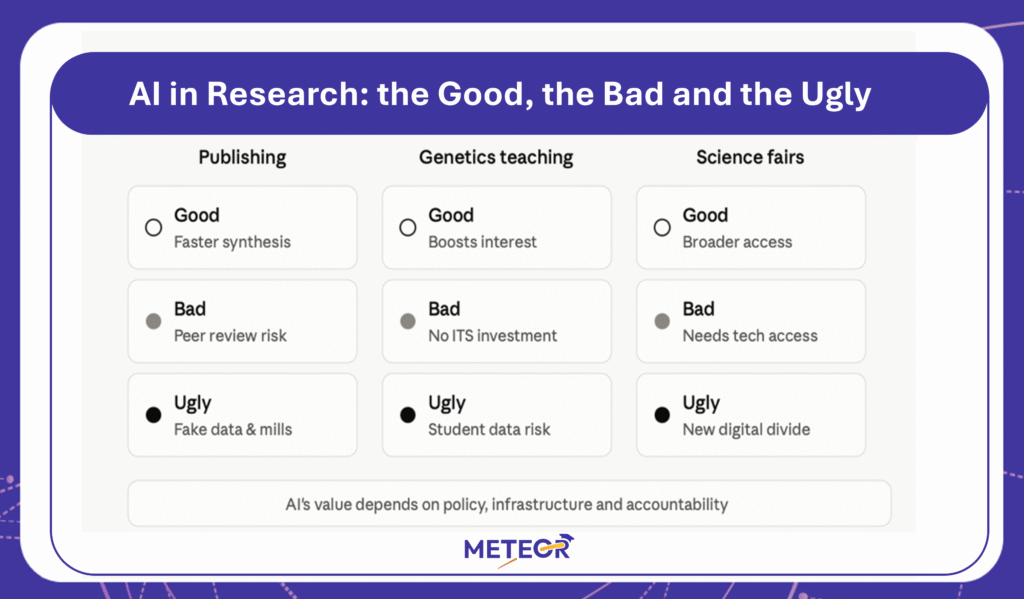
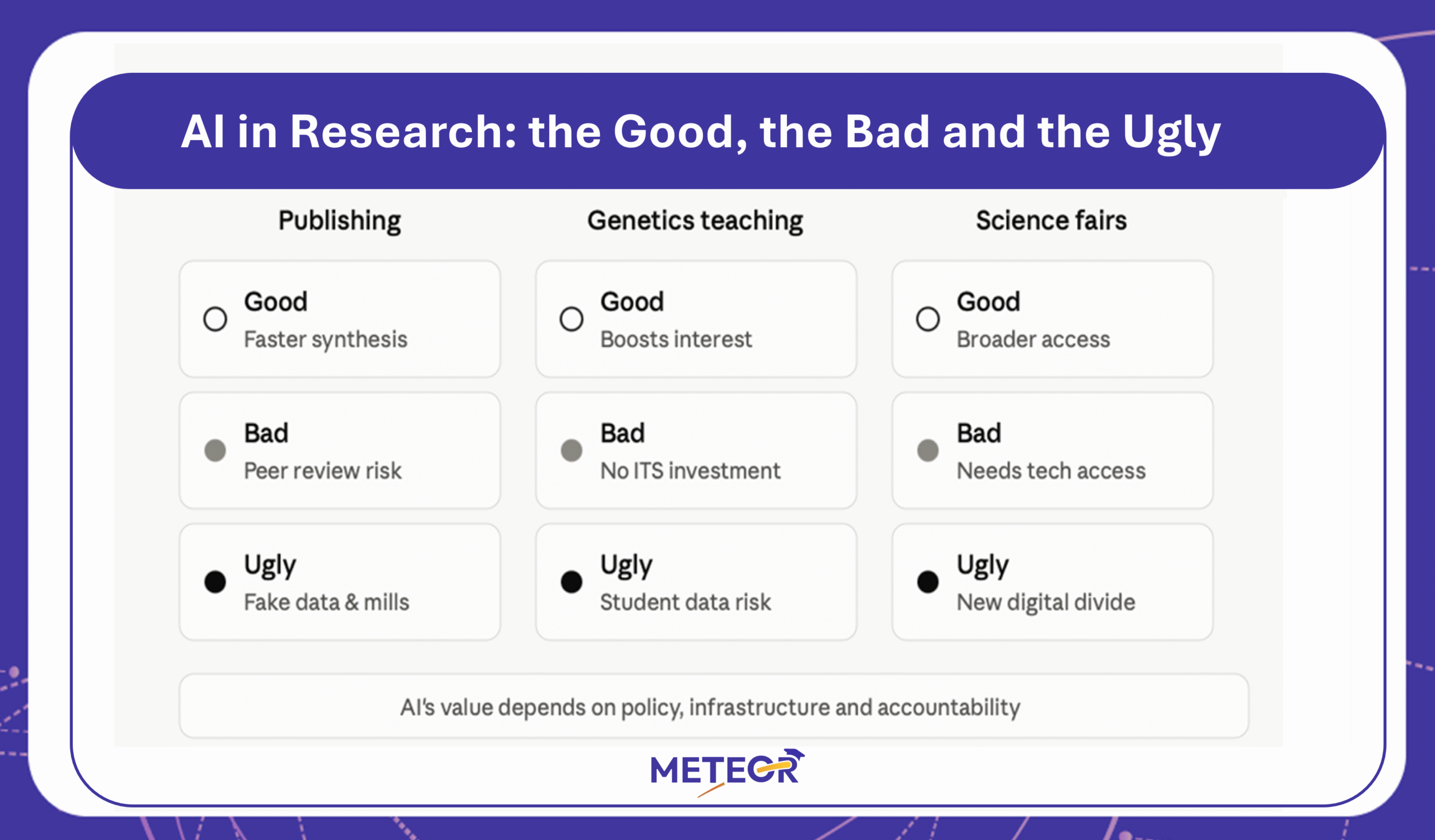
A recent METEOR Online Café brought together researchers to explore a question with no easy answer: where should we draw the line between good and bad uses of generative AI in science? Three presenters approached this question from different angles — scientific publishing, science education, and public engagement through virtual science fairs — but converged on a shared structure for the discussion: the good, the bad, and the ugly. Together, their reflections show that generative AI’s value is not fixed. It depends on discipline, context, policy, and the incentives that shape how researchers are assessed.
Salatino, opening the session, was explicit that the talk was not intended to demonise AI: “this talk is not about demonising AI, but actually it’s all about raising awareness.” The purpose, indeed, was to help researchers recognise where legitimate use ends and misuse begins — a line that is rarely obvious in practice.
Where Do We Draw the Line?
A central theme of the discussion was that judgements of ‘good’ and ‘bad’ AI use are not universal. They are shaped by personal values, disciplinary norms, and institutional culture, compounded by policy frameworks that remain fragmented and inconsistently enforced.
“It goes down to our inner values, what we consider good or bad, based on what kind of research department we have grown up, what institutions we have grown up, what kind of background we bring to the table” — Salatino
This ambiguity is compounded by the pace at which generative AI is being normalised. As new tools and use cases emerge daily, researchers risk internalising practices as acceptable simply because they have become common — only to discover later that a specific journal or publisher policy prohibits them.
“The more we normalise, the more we accept that this particular use is acceptable in a way… until we face the consequences that we realise, oh, okay, I didn’t know that” — Salatino
Salatino illustrated this with a student who had unknowingly included a generative-AI image in a paper, unaware that most journals prohibit such content. The lesson was not that the student had acted maliciously, but that familiarity with a specific journal or publisher’s GenAI policy cannot be assumed — it must be actively sought out before submission.
The discussion also connected this boundary-drawing to a deeper concern: the risk that researchers are shifting from creators of science to curators of AI-generated output.
“We used to be the creators of science, but lately we are more in the role of curators… we retain responsibility and accountability because AI cannot be liable, cannot be considered accountable. So, it’s us humans that have to be responsible. But we are losing ownership.” — Salatino
The Good: Legitimate Uses of Generative AI in Research
Salatino grouped legitimate uses of generative AI into four broad categories, framed around capability rather than any single tool:
- Synthesis and knowledge discovery — literature synthesis, semantic literature navigation, hypothesis generation, systematic review automation, and instant literature review drafting.
- Analytical and data-driven tasks — data curation, data mining, predictive modelling, biological concept recognition, and information extraction.
- Content generation and communication — generating narrative text from data, supporting researchers writing in a non-native language, multilingual dissemination, drafting and polishing, paraphrasing, and overcoming writer’s block.
- Research integrity and quality assurance — checking plausibility, fact-checking and consistency, pre-assessment of manuscript readiness, detection of fabricated content, and reference management.
These uses share a common feature: AI accelerates or supports tasks that remain under the researcher’s critical oversight, rather than substituting for the researcher’s judgement.
The Bad: Misuse, Carelessness and Ethical Lapses
By contrast, the ‘bad’ category covered practices that cross clear ethical or policy lines, even where they may feel like everyday convenience. These included using AI to conduct peer review — prohibited by many journals, and not yet capable of matching human-level review — and feeding a third party’s unpublished manuscript into a generative AI tool, which risks breaching intellectual property since submitted content may be used for further model training.
Other examples included content and language distortion, such as ‘tortured phrases’, where standard terminology is deliberately reworded to evade plagiarism detection (for example, rendering ‘mean squared error’ as ‘mean squared blunder’), hallucinated citations, and flawed image generation. Salatino pointed to a widely discussed case of an AI-generated anatomically implausible image that passed through peer review and was published in Frontiers before being retracted — raising uncomfortable questions about how such content passed authors, editors, reviewers and copy-editors unchallenged.
The Ugly: Weaponising AI to Corrupt the Scientific Record
The most serious category discussed was the deliberate, intentional weaponisation of generative AI to corrupt the scientific record. This included salami slicing — fragmenting a single piece of research into multiple minor papers to inflate output — and paper mills, review mills, citation mills and metric manipulation.
“…you are going to break this result that you have taken into atomical sub results and publish different papers. This is not ethical, mostly because you are fragmenting the knowledge” — Salatino
A striking case cited was a PhD student at MIT who fabricated an entire dataset. The resulting preprint was so convincing that it was endorsed by Nobel laureates before a formal investigation revealed the data had never been collected and no ethical consent had been obtained.
“It can happen to MIT, which is one of the most prestigious universities. So, it can happen to everybody. Nobody’s immune to this. It’s all about competition and misconduct.” — Salatino
This section closed with a discussion of retraction as the formal mechanism through which the scientific record is corrected. A retraction is not a deletion — the paper remains part of the record, but flagged, so that the community knows not to build further work upon it. As Salatino noted, a retraction also becomes a permanent mark on a researcher’s record, with consequences for future submissions.
The closing message reframed the problem: generative AI has not created research misconduct, but it has made existing bad practice easier to execute at scale.
“These kinds of practises existed way before GenAI… the problem are on the incentives, in the way we are assessed, in our stressful pressures and deadlines” — Salatino
AI in Genetics Education: A Nigerian Case Study
Adelana turned the same good–bad–ugly lens onto science education, drawing on a study of AI-based intelligent tutoring systems (ITS) for teaching genetics — a topic widely recognised as one of the hardest for biology students to grasp — among pre-service teachers in Nigerian secondary schools.
On the good side, generative AI was described as valuable pedagogical support in a context of high teacher workload, helping teachers create content that makes genetics more accessible to students. The study found that pre-service teachers demonstrated notably high behavioural intentions to use AI-based intelligence systems in teaching genetics, suggesting real promise for transforming genetics education.
“AI based intelligence system show real promise for transforming genetics education in the context of Nigerian secondary school, because genetics… is very, very difficult to understand for most of these students” — Adelana
However, the bad and ugly sides emerged in the gap between intention and infrastructure. Despite teachers’ willingness to adopt ITS, Adelana reported that there remains no singular, dedicated investment in AI-based teaching technology or laboratories for genetics in Nigerian schools. In the absence of institutional provision, some teachers have resorted to searching online for materials — with reports of student personal data being entered into AI tools in the process, raising data protection and safeguarding concerns.
“There is still a gap between capability, beliefs, and action… without deliberate policy investment on the part of the administrators, hands-on training on AI for teachers and targeted support for female teachers… there will continue to be poor performance in genetics” — Adelana
The implication, Adelana argued, extends beyond the classroom: persistent poor performance in genetics risks discouraging students from pursuing medicine, nursing and related fields — making this an infrastructure and policy problem as much as a technological one.
AI in Virtual Science Fairs: Access and New Inequities
Şardağ presented a third perspective, developed from a European Union open-schooling project that moved science fairs online during the pandemic, and considered generative AI’s role in virtual science fairs going forward.
On the good side, generative AI was described as a tool to make virtual science fairs more accessible, inclusive, and interactive — reducing the transportation and organisational barriers that exclude students in remote areas or under-resourced schools, and using AI-supported translation and language assistance to let students, teachers, and visitors from different countries interact, turning local fairs into an international space for science communication.
The limitations raised were practical: virtual fairs depend on strong technical infrastructure, reliable internet access, and suitable devices, without which the inclusive potential is weakened. Digital skills gaps among both teachers and students were flagged as a further barrier, alongside the loss of physical, hands-on experience that face-to-face fairs provide.
“We should not be seeing generative AI only as a technological tool… we need to integrate it into the teaching and learning process… otherwise, full contribution will remain limited” — Şardağ
The risks, or ‘ugly’ dimension, centred on data and equity. Uncontrolled or unplanned use of generative AI in this setting was flagged as introducing new ethical problems — particularly around the collection, storage, and analysis of student data — as well as risking a digital divide between schools with access to AI tools and infrastructure and those without.
“If AI-supported assessment or feedback systems are used in this platform, it should be clear how this system works. Otherwise, we face… trust problems” — Şardağ
Implications for ECRs and METEOR
Across all three presentations, a consistent message emerged: generative AI is neither inherently good nor inherently bad — its value depends on transparency, accountability, and alignment with policy and infrastructure. For early-career researchers and eco-outwards teams, this discussion points to several practical implications:
- Actively check journal- and publisher-specific GenAI policies before submission, rather than assuming common practice equals permitted practice.
- Declare AI use transparently, since researchers — not AI systems — remain accountable for outputs.
- Treat AI-supported synthesis, drafting and analysis as support for critical engagement, not a substitute for it, to avoid drifting from creator to curator.
- Consider infrastructure and equity before scaling AI-supported education or engagement tools, since access gaps can turn an inclusive tool into a new source of exclusion.
- Build ethics and data protection safeguards into AI-supported research and teaching from the outset, particularly where student or participant data is involved.
These implications connect directly to METEOR’s 8Cs framework (Okada et al., 2026), particularly Comprehending — understanding the shifting policy landscape around AI use — and Constructing, i.e. building research and teaching practices that are transparent, accountable and appropriately scoped to available infrastructure.
Conclusion: A Shared Responsibility
The three presentations, spanning publishing, education and public engagement, converge on the same underlying point: generative AI does not introduce new ethical categories so much as it accelerates and scales existing pressures — competition, incentive structures, and access inequities — that predate it. Drawing the line between good and bad use is not a fixed technical exercise; it requires ongoing engagement with evolving policy, infrastructure and institutional context.
For METEOR participants, this reinforces the value of transversal competencies that go beyond technical AI literacy: the judgement to recognise where a tool’s use shifts from support to substitution, and the responsibility to remain accountable for outcomes even as tools become more capable (Okada & Gray, 2023). Used well, generative AI can meaningfully strengthen eco-outwards research and teaching; used carelessly, or weaponised deliberately, it can just as easily corrode the trust on which the scientific record depends.
Authors: Salatino (Invited Speaker — AI in Scientific Publishing); Adelana (Invited Speaker — AI in Genetics Education); Sardag (Invited Speaker — AI in Virtual Science Fairs); Alexandra Okada (Chat Moderator, leader and editor of MOC – Meteor Online Cafe).
Author Contributions (CRediT): Salatino, Adelana, and Sardag contributed to the main presentations as invited speakers and to the revision of the transcript, summary notes and final version. Alexandra Okada moderated the session, prepared the summary notes, facilitated and synthesised the discussion, and contributed to writing — review and editing, including typesetting. All authors approved the final manuscript and agreed to the inclusion of attributed quotes from their contributions.
Citation: Salatino,A; Adelana,O; Sardag, M; Okada, A. (2026). AI in Eco-Outward Research. Published by METEOR — Methodologies for Teamworking in Eco-Outwards Research. CC BY-SA 4.0.
Use of AI: AI was used preliminary for transcription, synthesis and proofreading. The final content was revised and enhanced by all authors.
Keywords
Generative AI, Research integrity, AI in science education, Online doctoral collaboration, CARE–KNOW–DO framework, Transversal researcher skills, Inclusive research practices
Acknowledgements
We are grateful to all participants in the METEOR project for their valuable contributions, and to our peer reviewers for their generous and insightful feedback.
References
METEOR (2026). Methodologies for teamworking in Eco-outwards Research. Available at: https://www.meteorhorizon.eu/meteor-programme/.
Okada, A., Sheehy, K., Rossade, K.D. and Bandara, A.K., 2026. Developing Researchers’ Competencies through CARE–KNOW–DO and upSKILL. Map, aligned with EU and UNESCO Priorities. Open Research Europe, 5(333), p.333.
Okada, A., & Gray, P. (2023). A climate change and sustainability education movement: Networks, open schooling, and the ‘CARE-KNOW-DO’ framework. Sustainability, 15(3), 2356.