

Building Research Capacity Through an Inclusive Researcher Network
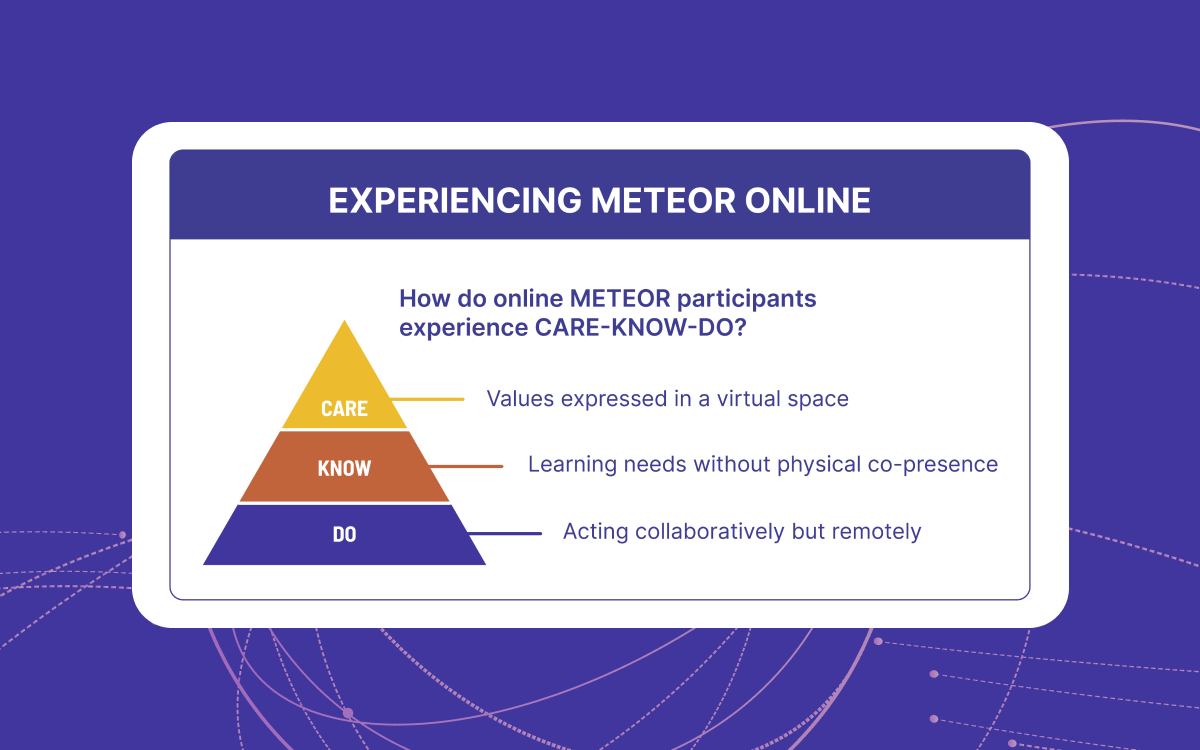
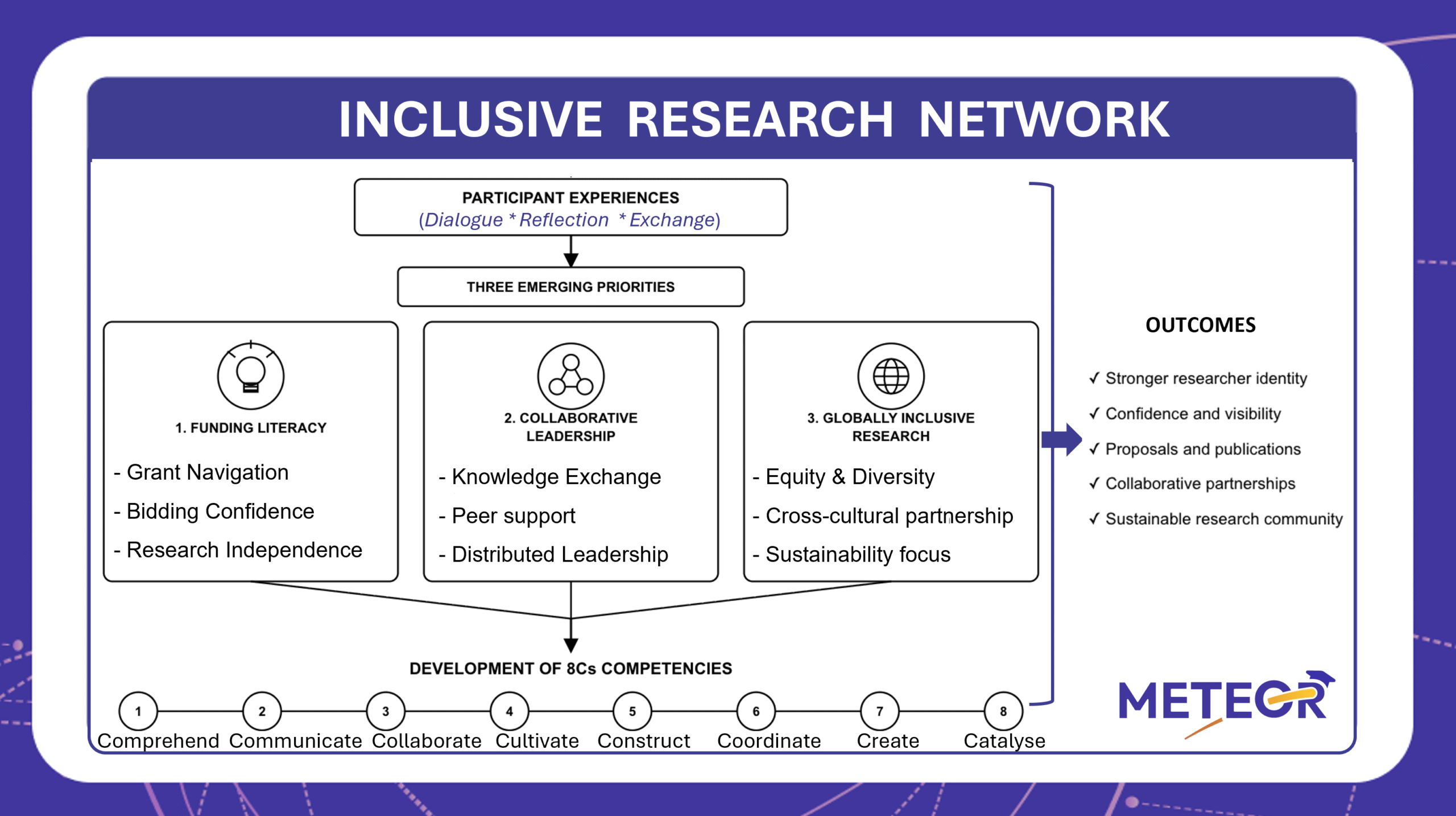
This article explores how online collaborative spaces can sustain early-career researcher engagement beyond formal training by fostering connection, confidence, and professional growth. Drawing on participants’ experiences, the article identifies three priorities—funding literacy, collaborative leadership, and globally inclusive research—that help researchers translate dialogue into proposals, publications, and collaborative partnerships. It argues that METEOR Online Cafés have the potential to become sustainable, participant-led communities that strengthen research capacity while advancing the CARE–KNOW–DO framework and developing researchers’ 8Cs competencies.
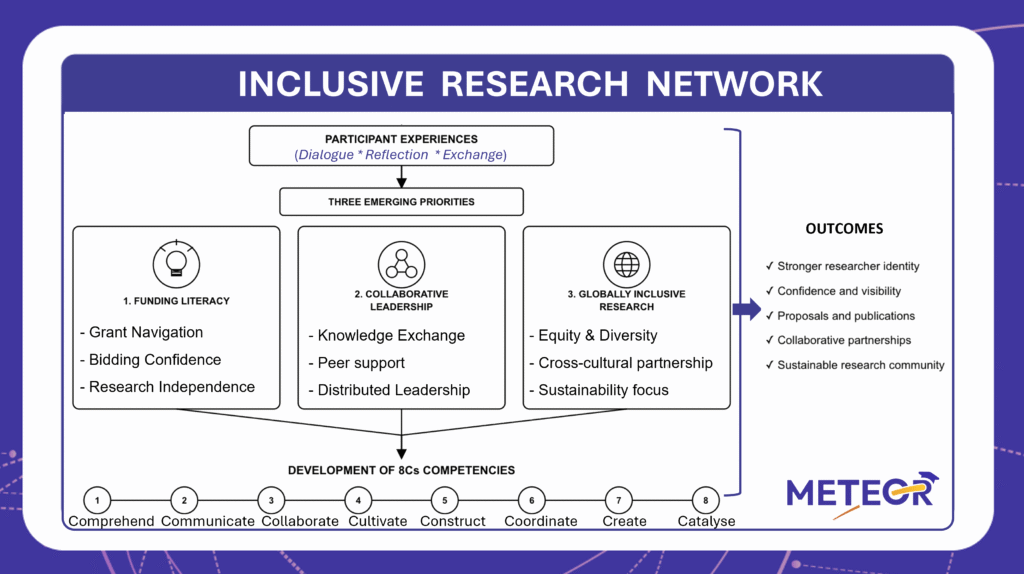
The European Commission-funded project METEOR (Methodologies of Teamworking for Eco-Outwards Research) aims to support researchers’ professional development by creating shared spaces for collaboration across disciplines, career stages, and geographical contexts. Aligned with this aim, the METEOR Online Café (MOC), led by the Open University in the United Kingdom (OU-UK), is evolving into a vehicle for sustaining engagement. By offering regular spaces for dialogue, reflection, and exchange, MOC engages eco-outwards research participants—including both mentors and learners—while enabling them to connect their involvement in the project to longer-term research and career trajectories.
Based on discussions held across a series of MOCs, each event involving approximately 15 participants from different knowledge fields and career stages, this article addresses the following central question: What are participants’ interests, needs, and motivations for engaging in the METEOR programme, and how can these insights inform the development of an inclusive research network during and beyond the METEOR project (2025–2027)?
Across the cafés, what emerges strongly is not a demand for more information about the METEOR programme, but a clear interest in professional networks, continuity, and progression. MOC participants consistently expressed a desire to feel included as part of an active research network, to translate participation into tangible professional outcomes, and to navigate collaboration, funding, and visibility with greater confidence, enhancing all key competencies embedded in METEOR’s 8Cs framework (Okada et al., 2026). These insights point towards the importance of understanding engagement not simply as participation, but as an evolving process that links connection to development and progression over time.
Participants’ interest in MOC reflects the role these spaces play in keeping METEOR visible and meaningful across different phases of the project. Regular points of reconnection help prevent engagement from becoming fragmented or episodic, supporting continuity while enabling participants to situate their work within a broader collective (Wenger‑Trayner and Wenger‑Trayner, 2020). Building on this continuity, participants demonstrated a strong interest in advancing towards more concrete outcomes, particularly by gaining experience in collaborative funding applications, especially within European contexts.
Participants emphasised the importance of opportunities to move beyond discussion towards action, bridging between learning, collaboration, and output. This was shown in participants’ interest in presenting work, sharing ideas developed through academies, and continuing collaboration beyond formal sessions. They expressed the need for supportive, interdisciplinary spaces where emerging research ideas and work in progress can be tested and refined before moving towards publications, proposals, or wider dissemination.
Taken together, these insights inform a forward-looking perspective in which the MOCs are understood as evolving platforms that potentially could support sustained engagement, capacity building, and network development within and beyond the METEOR programme cycle. The following section therefore examines how these dynamics can be translated into more structured, future-oriented approaches to strengthening research competencies and fostering an active research network.
Three themes emerged from discussions.
Theme1: Funding Literacy, Bidding Confidence, and Career Navigation
One of the most prominent emerging themes from participant discussion relates to funding, bidding, and career development. Participants expressed a strong interest in developing the skills and confidence needed to navigate grants and fellowships, particularly at early career stages. Rather than abstract guidance, they value opportunities to learn from peer experience — understanding how others approached applications, interpreted eligibility criteria, and responded to challenges in the bidding process. These needs are well documented in the literature on early career researchers, which highlights funding literacy and access to grants as central to research independence and career progression (Raith, 2025).
An early-career researcher expressed an interest in four of the 8Cs skills for developing proposals and projects through teamworking – collaboration, cultivation, construction and coordination. “I am interested in collaboration—constructing partnerships, cultivating joint efforts, and coordinating resources and networks effectively to achieve shared goals.”
Future MOCs could therefore function as spaces for building funding literacy as a shared competence.
- Develop practical understanding of grant and fellowship landscapes.
- Learn how research ideas translate into fundable projects.
- Build confidence to see themselves as future applicants and project leaders.
Embedding these conversations within community dialogue strengthens the link between research design, professional development and community engagement in METEOR. In this way, funding literacy is not viewed as an individual skill acquired in isolation, but as a collectively developed competence, shaped through dialogue, comparison, and reflection
Theme 2: Collaborative Knowledge Exchange and Distributed Leadership
A second core theme relates to collaborative knowledge exchange and the development of leadership within a research network. Participants expressed a clear desire to move beyond passive participation towards more active forms of engagement, including presenting their own work, leading discussions, and shaping the direction of future MOCs. This reflects a broader shift in how participants understand their role within METEOR: not only as recipients of training, but as contributors and co-creators of knowledge.
In discussions, participants emphasised the value of spaces where they could test ideas, receive feedback, and engage in interdisciplinary dialogue without the pressure of formal evaluation. Such environments were seen as critical for building visibility, confidence, and academic identity.
A third-year doctoral student highlighted three of the 8Cs skills – comprehension, communication, and collaboration. “I would like to ensure that policy becomes practical by first understanding the local context. Research should not stop at conducting studies and publishing papers; it should communicate findings and translate them into practical actions by collaborating closely with ministries, non-governmental organisations, and other stakeholders.”
Research highlights that early-career researchers benefit from environments that actively support leadership development and peer-driven knowledge exchange (Chisholm and Finelli, 2023). The MOCs are well-positioned to fulfil this role by functioning as co-produced spaces where participants can:
- develop skills in research communication and public engagement.
• engage with policymakers and explore pathways for collaborative impact.
• contribute to interdisciplinary knowledge production.
Previous MOCs have brought to the fore a strong and consistent emphasis on equity, diversity and inclusion across education, gender, healthcare and innovation and representation of marginalised voices in research. These themes are not peripheral but central to participants’ motivations for engagement, shaping the kinds of discussions they wish to lead, the collaborations they seek to build, and the forms of knowledge they aim to produce. As such, a focus on equity, diversity and inclusion themes becomes an important driver of participation, reinforcing the need for inclusive, dialogic environments where diverse perspectives can be meaningfully integrated into collaborative work.
These reflections further illustrate how these processes and spaces can reshape perceptions of leadership. Rather than being understood as a hierarchical role, leadership emerges as distributed and relational, grounded in participation, contribution, and mutual support (Raelin, 2016). This not only enhances individual competencies, but also strengthens collective ownership of the MOC space, reinforcing its potential role in sustaining engagement in the METEOR programme.
Theme 3: Globally Inclusive Research for Sustainability and Fair Societies
A third area of emphasis concerns research that is socially responsive, ethically grounded, and attentive to diverse global contexts, which is aligned with the concept of eco-outwards innovation for people and planet.
Participants expressed interest in engaging with other countries’ perspectives and contexts beyond their own geographical location, including research connected to Global Majority and other underrepresented regions.
A second-year doctoral student emphasised five skills of the 8Cs – comprehension, cultivation, catalysis, collaboration, creation “I am interested in comprehending the intersections where digital technologies can be leveraged to foster and cultivate inclusion. I want to catalyse collaboration among a wide range of stakeholders and transform impactful strategies into effective and inclusive teaching practices.”
In this sense MOCs can function as spaces for strengthening multi-sector and multi-national conversations, where participants can:
- Engage in global and cross‑regional opportunities for knowledge exchange.
- Discuss context‑sensitive and ethically grounded research practices.
- Reflect on inclusive approaches to knowledge production and dissemination.
These interests align with broader calls for more inclusive and globally connected research practices (Jackson et al., 2022; Flint‑O’Kane et al., 2023) and are in alignment with METEOR’s eco-outwards orientation including the CARE dimension of the CARE–KNOW–DO framework (Okada and Gray, 2023, Okada et al, 2026). By foregrounding these dimensions, participants could be supported in working across geographical, cultural, and epistemic boundaries with greater awareness and confidence.
Conclusion: Sustaining
This article has shown participants’ interests, needs, and motivations within METEOR, and how the Online Cafés can support the development of an active research network within and beyond the programme. Participants are seeking meaningful opportunities for connection, progression, 8Cs skills – communication, collaboration, cultivation, creation, construction, comprehension, coordination, and catalysis that lead to tangible research outcomes. Across the MOCs, participants highlighted the importance of belonging to an active research network, developing confidence, and engaging in collaborative work that supports both individual and collective growth. In this sense, engagement is not participation alone but a process that links connection with competency development and progression.
MOCs have the potential to function as more than reflective spaces in the METEOR programme. When intentionally designed, they can support the development of key competencies, foster collaboration, and enable the translation of ideas into outputs such as proposals, publications, and partnerships. The strong emphasis on equity, diversity, and inclusion further highlights the importance of maintaining inclusive, participant-led environments that reflect the values driving engagement.
Looking ahead, the role of the MOCs will be most effective if they continue to evolve as structured, yet flexible platforms that support both community-building and professional development. By creating opportunities for participants to contribute, lead, and collaborate, the MOCs can help sustain engagement and build a connected, confident research network that extends beyond the METEOR programme, transforming short-term project participation into longer-term research capacity and collaboration.
Authors: Jane Doka, Alexandra Okada, Owolabi Adelana and Laud Freeman
Author Contributions (CRediT): JD contributed to the investigation, synthesis of findings, and writing – original draft. AO developed the investigation framework and methodological approach, integrated qualitative data, created the graphical abstract, and undertook review and editing of the final version. OA and LF contributed to discussion and data generation. All authors read and approved the final version.
Citation: Doka, J.; Okada, A.; Adelana P; and Freeman L. (2026). Building Research Capacity Through an Inclusive Researcher Network. Published by METEOR – Methodologies for Teamworking in Eco-Outwards Research. CC BY-SA 4.0.
Use of AI: AI was used for transcription, synthesis and proofreading.
Acknowledgements
We are grateful to all participants in the UK METEOR project for their valuable contributions. We also thank our OU mentors, Dr Margaret Ebubedike and Professor Inma Alvarez, for their thoughtful peer review and constructive feedback, which greatly strengthened this article.
References
Chisholm, K.I. and Finelli, M.J. (2023) ‘Enhancing research culture in academia: a spotlight on early career researchers’, BMC Neuroscience, 24, 46. Available at: https://doi.org/10.1186/s12868-023-00816-1.
Doka J, Okada A, Joshi P, Baitimbetova M, Robinson K, Hedges C, Holland-Szyp C, Osys S, Horne J, Weir G. (2026). CARE-KNOW-DO: Doctoral Researchers’ Experiences of the METEOR Programme Online. Published by METEOR – Methodologies for Teamworking in Eco-Outwards Research. CC BY-SA 4.0. https://www.meteorhorizon.eu/2026/05/08/care-know-do-doctoral-researchers-experiences-of-the-meteor-programme-online/
Flint‑O’Kane, M., Bain, K., Chisanga, B. and Patel, S. (2023) Africa–UK research partnerships for development. London: Association of Commonwealth Universities. Available at: https://www.acu.ac.uk/our-work/policy-and-advocacy/briefings-and-communiques/africa-uk-communique/.
Jackson, J., Moloi, K.C., Ogude, N. and Tshivhase, A. (2022) ‘Pathways to research leadership for early‑career researchers in Africa: a potential role for African and global funders’, South African Journal of Higher Education, 36(2), pp. 1–18. Available at: https://doi.org/10.20853/36-2-4697.
METEOR (2026) Methodologies for Teamworking in Eco-Outwards Research. Available at: https://www.meteorhorizon.eu
Okada A, Doka J, Hayat M, Payne H, Akinwoya S, Dery P, Dawuda L, Boateng F, Bailey M, and Porter M. (2026). Reflections on Transformative Learning for Eco-Outwards Researchers. Published by METEOR – Methodologies for Teamworking in Eco-Outwards Research. CC BY-SA 4.0. https://www.meteorhorizon.eu/2026/05/08/reflections-on-transformative-learning-for-eco-outwards-researchers/
Okada, A., Sheehy, K., Rossade, K.D. and Bandara, A.K. (2026) ‘Developing researchers’ competencies through CARE–KNOW–DO and upSKILL.map’, Open Research Europe, 5(333)
Raelin, J.A. (2016) ‘Imagine there are no leaders: Reframing leadership as collaborative agency’, Leadership, 12(2), pp. 131–158.
Raith, M. (2025) An investment in early‑career researchers is an investment in the future of higher education. European University Association. Available at: https://www.eua.eu/our-work/expert-voices/an-investment-in-early-career-researchers-is-an-investment-in-the-future-of-higher-education.html
Wenger‑Trayner, E. and Wenger‑Trayner, B. (2020) Learning to Make a Difference: Value Creation in Social Learning Spaces. Cambridge: Cambridge University Press